I see Unity lasting a long time. There are basically only two companies to consider if you want to make a 3D game: Unity and Unreal. Unity is so much easier to pick up for newer game developers, which means Unity will always have a funnel of new users that will help the company stay afloat. The decision to use C# is a major factor in Unity's success. Not only do you get the benefit of an existing ecosystem, and you also don't need to worry about the insanity that is C++. The biggest threat to Unity is probably Godot achieving a Blender-like success story where Godot achieves parity with Unity but is free.
New game developers don't make any money. The gaming industry, both free and paid titles, is overwhelmingly hit-driven, and bigger professional teams can more consistently deliver high quality content.
Considering cost of development and time, the average title most likely loses money. People were basically LARPing as game developers, and throwing money at Unity for the privilege. As economic conditions deteriorate, its reasonable to expect people to stop doing that.
That's harsh in my opinion. In entertainment and media there are always more people who want to do a thing than can be supported: musicians, actors, comedians, artists, etc.
Sometimes amateurs become pros. Sometimes people "LARPing" -- as you call it --make games I really enjoy. So I think its cool that people try their luck at game development even knowing most won't make a living at it.
So true! Sometimes to scratch my itches I have joined first timers- I guess me “LARPing” as a garage developer. It usually becomes clear they will never even finish a prototype.
Once I joined a team that was making a space ship combat game. All they worked on was 2d buttons, sliders, etc. Building a whole GUI from scratch for months. I stuck my head up to say maybe we could try some gameplay ideas? No it was important to get the menus right.
> People were basically LARPing as game developers, and throwing money at Unity for the privilege.
If you make a game, and it struggles due to very tough market conditions, you are not LARPing as a game dev. You are a game developer. There are countless gems on steam that have not gotten commercial success, but are well engineered and well designed titles.
I don't think that's a realistic definition. It all has to do with intention. LARPers, by definition, are role-playing and not actually intending to do the thing. A painter who never makes a sale or never finishes, but intended to, just failed at the task.
The median title on Steam earns only $3,000 in sales over the first year
That number is probably way overstating the median revenue. It is based on a non-random sample (hey devs, send us your data for a survey) of 75 games. Looking at a larger dataset, a majority of developers make <$1,000 (average revenue: $294).
If your company (or personal LLC) is only making $3000/year in revenue, you can use Unity for free (the threshold where you need Unity Pro is $100K/year). So even if fewer people are doing those kinds of “nights and weekends passion project” games, it’s not likely that it’s affecting Unity’s overall revenue that much.
Right, but some of these passion projects in turn become breakout hits that breach the 100k barrier then presumably generate revenue for Unity - think of indie games that break out into mainstream built on Unity like Among Us or Valheim. If the reduction in passion project games is significant enough it might well have an impact - especially as fewer "AAA" style development houses pick Unity.
I agree Steam games are a difficult market to break into, but there are other ways to make money. Unity is also a nice platform if you want to produce interactive content for corporate or educational consulting projects.
Also consider the large number of places such as Hobby Lobby, Williams-Sonoma, or Home Depot that cater to hobbyist/amateurs rather than industry professionals.
Steam is kind of irrelevant. If you look through Unity job postings, almost all of them are in the mobile market (where Unity dominates) with the rest being gambling or web3 vaporware
Even if there are fewer amateur game devs in the next few years, the pool of people who've been doing that in the last few years is where the big pro teams will be recruiting from, and a lot of them are familiar with Unity and will want to keep using it (and even if you don't care about their preferences, they will be more productive more quickly in teams that do).
What is the median lifetime sales? Or over a 5 year window? I don't think first year is the end-all, be-all here given how being a gamedev actually works (e.g. what if I release 5 games in 5 years?) But it's possible first year sales are effectively lifetime sales on average as well.
There is a long, slowly accumulating tail but to get there you need to survive five years and five releases. And least some of those need to be more successful than the median to generate real revenue in the tail. It also comes with increased expense in terms of maintaining those games, both the codebase itself and the marketing around it. For all that you’ll probably pull in a mediocre salary for a single developer.
I think that's where Godot is headed. The Godot editor is so much more enjoyable to use, the docs are good, the script editor is nice, and the node system makes it really simple and fun to iterate and build stuff. Very lightweight and beginner friendly. I would be surprised it Godot + Blender don't become the future pipeline for indie devs. But they do have a ways to go. 4.0 is showing a lot of progress.
Unreal seems to have made great strides to make their engine more approachable by outsiders. Five years ago you had a stronger argument, these days I'm not so sure.
Although blueprints are great, once you have to touch C++ it’s not so great. Tools like Rider for Unreal make it much, much better though. C++ is king of game dev and everyone hates it. Unreal is not regular C++ and handles a lot of resource management for you, but it’s still C++.
I’ve used C++ for near 10 years and I don’t hate it (that’s a lie I hate it with a passion), but C# is just has much more flexibility, has better error messaging, easier to integrate 3rd party libraries, better package manager, better namespaces, no header hell, no memory leaks, exceptions with useful information, reflection, and so much more. C++ has raw speed.
I know most won't take that seriously, but GodotEngine is a pretty nice alternative.
Godot is kind of the Unity of Unreal. Meaning it is the runnerup but is picking up the pace quite quickly.
And from also working with Unity my personal experience is that the stuff in Godot is a lot more logical than how it's done in Unity.
This is of course a personal preference but it feels like Godot has a lot more "eat your own dogfood" going on
God I would love for Unity to offer a Swift (no GC, fully type safe, compiled, fast) API with a rethought API surface. And have only one renderer to choose from instead of 3 with all different features.
C# on Unity is very different then what you expect. Different base class library, stack instead of heap objects, heap arranged to allow fast iterating over them. It is C# but it is not your typical .NET. And .NET done right is in the performance region where other aspects kick in (like network or UI bottlenecks).
There's a ton of mandatory reference counting in almost every contemporary graphics driver. I also hate reference counting overhead, but it really isn't as big of a deal as you're making it out to be unless you use it for stuff like references in render passes.
There's nothing wrong with reference counting. Manual reference counting using a technique like pointers into a generational array is fine. When the reference count goes to 0, release the generational memory. Any dangling pointers can handle the null value returned when trying to read the generational memory. That's a totally fine solution to reference counting.
My issue is with automatic reference counting. It's just way too easy to hold on to a reference accidentally, especially now that lambdas / closures are an essential language feature. I don't have much Swift experience, but I do have a lot of Objective-C experience, and it's just way too easy to accidentally capture self or some other value. In game programming, there is very little concept of ownership. Everything exists as peers that can modify each other. This leads to a high likelihood of reference cycles.
I have not found in my own game programming experience that there's a whole lot of pointer soup, except in temporary scopes that can use stuff like arenas (indeed, this would be pretty terrible for performance) and there's usually a pretty clear ownership structure to be found (ownership may be muddled in a logical sense, but this isn't that relevant from a memory management perspective). Perhaps this is because I'm using a language that doesn't mandate reference counting though, so it's easy to do stuff like just build up temporary references into arrays etc. when necessary...
I mean the #1 issue with Unity performance is GC pauses which are very easy to create. Swift of course has tools for dealing with circular references. I’d certainly take the trade.
I’m not sure how much of a performance hit ARC traffic would be. Though I think at least some of Unity’s DOTS systems really on structs instead of reference counted objects so it shouldn’t be a problem there.
Not ARC per se but the message dispatch mechanism was the biggest hurdle to high performance Objective C. The solution was easy : drop to C. Not really the best options for ease of approach :)
Swift structs should work for that too. But also DOTS is like years away from being ready it seems like. Basically hacked into the engine and language and kinda over complicated and confusing at the moment.
Unreal has Blueprints that are superior to all Unity's visual scripting solutions, so if you're a beginning indie dev, you don't need to write code at all.
If, however, you're a professional game developer who tries to get his game to run 60 FPS on a 6-year old phone (not a hypothetical example, I've led a project that had 60 FPS on iPhone 4 in 2016 with Unity), then you WANT the C++ and engine source code.
I've been working with Unity since 2009 and hope to never touch that giant flaming pile of shit again in my life. Having moved to frontend development still, I'm very happy to work with tools that mostly work, and if they don't, you can actually dig in and debug them, with healthy development culture that actually encourages you to do so.
Sorry for the emotional rant; 10 years of Unity experience (not really though, I've done other things in this time as well) do that to a person.
Hopefully Godot can make some progress there once 4.0 is out. They're making some very large changes that are supposed to drastically improve 3D performance.
The big risk to products where better UX is a differentiator is that it's easy for competitors to catch up and you need to keep moving. I tend to agree that Unity will be around for a while, but I'm not sure it will keep its same prominence. It's losing its first mover advantage.
Bethesda/Microsoft bought them and took it off the licensing market, but it also seems questionable to me if it had a future there anyway, because they seemed to have gone all-in on large but totally static environments with Rage, something which has not changed with Doom. That's not something that really works for many games.
I've seen this from both the developer and consumer side of things. The legacy design of Unity encouraged truly terrible code designs which translate into sub-optimal performance on modern hardware.
Performance and tooling have historically driven game engine licensing. There's a reason why Unity has a noticeable lack of presence in so-called triple-a gaming. Believe me, if performance was "pretty good" and tooling was "excellent" then every major studio would be using Unity. Instead, they're overwhelming using Unreal or they're using their franchise engine that they've built over 1 or 2 decades similar to id Software whose engines used to be the direct Unreal competitor.
As a consumer, I cringe when I run game that is "powered by Unity". They nearly always feature extremely slow loading and sub-optimal framerate on top tier hardware. In contrast, an id or Unreal engine game will run at 4k 60fps while looking beautiful.
On another note, Unity's market has always seemed to be indie and double-a studios. I would expect a recession to cause many who would have "taken a year off to make a game" to change their minds as investments or savings drawdown.
They may not qualify as AAA, but Hearthstone, League of Legends: Wild Rift, Kerbal Space Program, Cuphead, Gwent, Genshin Impact, ReCore, Ori 1 and 2, Hollow Knight, Fall Guys, Pillars of Eternity, Call of Duty Mobile, Subnautica, Firewatch, and Valheim are pretty big games; some indie hits but many are produced by major studios.
For one thing, I think the "powered by Unity" branding is a problem, because you only see it on games that couldn't afford to actually pay for Unity and therefore have a larger chance of being poorly polished.
The "powered by Unity" is only required by less expensive Unity subscriptions so it's boarder line anti-branding. People think Unity sucks because only low budget games advertise that they're made with Unity.
It is not limited to games that use free versions of the engine. I can't think of a unity game aside from the couple of mostly 2d games like Ori and Cuphead that weren't crappy.
I meant that they ran like crap. Didn't want ti say that they were bad games, some of my favorite games are made in unity(ksp), but I really wish they weren't.
A lot of studios are starting to pick up Unity. It’s not that Unity can’t make AAA games, it’s that most of the workforce is used to C++ and Unreal style engines. Most A and AA games are being made with Unity nowadays. Unity started getting popular in mobile dev where it’s still king and now those devs are slowly moving on to bigger better games.
Counterpoint: Windows works with 30 year old code, and somehow managed to manage their piles of tech debt and still work. Still a huge % of the market.
Have you ever looked at the source code of the NT kernel? (there have been a few leaks over the years)
Windows is indeed full of old and new crust, but the foundations are actually not bad, NT is a pretty good kernel if you ask me.
The quality of Microsoft engineering is often underestimated, mostly because it is all over the place, different teams, a huge amount of technical debt, but in my opinion some key pillars have been built well enough and maintained, and they also managed to deal with the crust and survive without falling into the classic trap of the second system syndrome.
> Windows works with 30 year old code, and somehow managed [...]
I don't think Microsoft has any particularly secret sauce here, they just have a good reason to keep it going and the money to do so. Many other cases the money just isn't there.
And don't under estimate the herculean efforts Microsoft goes through, or eat least used to go through, to keep old programs running. It goes far beyond what I would have ever imagined had I not talked to some of the people involved with it. We're talking having the OS detect specific versions of specific programs (e.g. old versions of Quicken) and hot patching specific APIs with bug-compatible behavior so they don't break with an OS upgrade. Microsoft definitely takes backward compatibility seriously.
Because microsoft dominated a market segment with mostly no competition for long enough to make people dependent in a way that users couldn't simply choose an alternative. There are idiosyncrasies in windows usage that users think are normal, but are actually legacy behavior which can't be changed because it could break other peoples tools. This makes windows users not only locked on the platform but also expect those misbehavior if they try to change. Also consider that depending on the hardware, software or services you use, there is NO alternative to windows.
I'm kinda sad that we have really ended up with essentially two operating systems or families of such dominating. Unix/Linux/BSD and Windows... Both with their own issues and historic loads...
I feel that we could do so much better in modern age if some of the things were just let go, but trenches has been dug and nothing will likely happen.
Uhhh ... macOS is exactly what you're talking about. It's unafraid to let some things just go. They just said during the State of the Union this week that Obj-C and UIKit were legacy tools, and that the future is Swift and SwiftUI. They said it, and I promise you they will deliver on this. I predict that within a decade Apple will truly deprecate UIKit and AppKit and stop any new app from using it. Microsoft has never been able to do that.
Nothing is deprecated, they just recommend Swift and SwiftUI for new apps.
And while they could deprecate UIKit in ten years or more, C and C++ won't be deprecated any time soon, they just starting working on Swift and C++ bridge too.
Swift on iOS still has support for C/C++ interop via bridging headers. I imagine that would be preserved even if Obj-C was deprecated as a broader iOS runtime. Eliminating C/C++ in one fell swoop would be disastrous.
They will try, but a decade is far too brief for that to happen. Swift was introduced eight years ago and there are still plenty of apps, especially ones belong to large corporations, that contain Objective-C legacy code. Including Apple's own apps. Maybe once SwiftUI gets its Swift 5 moment when there's a release that's stable enough going forward.
They were also smart enough to parallel development with Windows 95/98 -- creating two mostly compatible operating systems for different segments until the need for backwards compatibility and the power of the hardware made it possible to obsolete the DOS line.
If you’re talking about the Windows OS itself, the OS kernel is very good and has pretty solid foundation. Windows NT was based on VMS which was an excellent cutting-edge OS of the time.
It's a bit of a stretch to say it was "based on VMS."
Yes the core initial engineers and leadership that started it were ex-DEC engineers.
But if you listen to Dave Cutler's interviews and read about it you can see clearly that some concepts were borrowed but much of the thinking was from scratch. He took the chance of starting a greenfield project to make something far more current.
In particular NT was designed from the ground up to be multiprocessor and multithreading friendly, which is not the case for VMS.
Secondly NT was designed to host multiple OS "personalities", VMS not at all.
Finally NT was designed to be portable between ISAs and they spent years making sure it worked equally well on MIPS, PowerPC, Alpha, x86, and then amd64.
NT the kernel is awesome. I just wish they'd shipped a better userspace from day one.
Imagine if Microsoft had shipped NT with a proper Unix-like shell environment in the 90s and not the crap "command.com" and WinCRT.dll garbage. What a better world we'd live in.
Windows NT learned from DOS, Win 3.1, and Windows 95 though. They had 4 generations or so before they made an operating system that was stable and maintainable.
Windows NT is the brainchild of Dave Cutler. Cutler was one of the tech leads on VMS. He was only hired away from Digital when they shitcanned his “Project Rainbow” follow up to VMS.
Ultimately software becomes medicine, not human or veterinary medicine, but computer medicine. You have all this code, but you can't read it all and can't check if it's right. Then you end up with tumors in the code (Blas Mena came up with this concept) and they can be benign or malignant, and ought to be contained. Tumors can be 500 lines of C#, ballpark, in a 15000 LOC codebase.
Yes LOC, lines of code, is a bad metric--compared by Bill Gates to weight on an airplane--but at the end it is still meaningful to the complexity--mass of an airplane.
So the whole game in software companies is at some point taking Human Growth Hormone and growing fast, and inevitably getting some tumors, but hoping they are benign and contained. Or they can spread and the software dies.
Unity is the #1 game engine used today. It started from nothing and bypassed Unreal. That's a very impressive feat. Also, it is so much easier to use than Unreal. So I don't see the problems you are talking about.
Alluding to this, at what point can such a huge company say that we have technical debt and that we'll be focusing on refactoring and making the base solid instead of releasing new features?
But they have been working on this for 5 years now, and it is still "experimental", also the community response has been kind of lukewarm, many devs don't really understand why this is necessary.
I read that the dots team went dark over a year ago. People are speculating that the whole thing was either canceled, or they are planning to release a completely separate game engine rather than try and shoehorn it into the GameObject model.
They have made fun about being relieved that XNA had only been a framework rather than an engine. MonoGame http://www.monogame.net might actually outlive Unity in the end. In any case, the Unity founders will be millionaires.
Monogame is missing a lot of features if you're wanting anything but the basics in 3D (it's still very good for 2D games). I tried hard to use it instead of Unity (for over a year), and only recently switched to Unity because I wanted to add VR support, and forgot just how much easier doing 3D in Unity is compared to Monogame.
Like I was fighting Monogame on model rendering, textures, shaders, cross-platform (never could get a high-res 3D working for the Mac version), anti-aliasing, etc. Everything 3D was being a pain in the ass to get working, and my progress was very slow.
After one day of porting my assets over to Unity, doing some tweaks in the editor, and importing a few assets from the Unity store, and my game already looked better than it ever looked in Monogame (still working on porting the rest of the game).
It should be said that I'm not an expert 3D developer, I'm much stronger in 2D, but have been trying to do more in 3D lately, and that may be part of why I struggled with Monogame in 3D. People who have no issues coding in OpenGL or DirectX directly probably won't have as many issues as I did.
Unity is for games. Without the games market, a company like Unity can't exist. Unreal Engine is used for dataviz and media production projects, but it's business is games.
His point is that if Excel lost the business world, the fact that people do things like write games in Excel will not save it, and he is asking you to understand that the assertion that Unity is used for more than games is roughly analogous, which it is.
That isn't what that commenter is saying. What he's saying is that engine licensing isn't the bulk of their revenue, other non-game-revenue-dependent services are. Those services are _game_ services that happen to not be tied, like the license of the engine itself, to the published game revenue.
That commenter does say that most of their revenue doesn't come from the engine, because that's what the numbers tell you. It's also what I just said, I just summarized it to engine + more.
Please don't claim it's similar to making games using Excel, it really isn't. But it explains why I didn't understand what he meant, so that's something at least.
What I am trying to tell you is that the revenue breakdown you are using to justify this statement doesn't actually say that. What it says is that due to unity's pricing model, the bulk of the revenue they are making isn't all engine license revenue (which is both game and non-game), it is other services, almost all of which such as voice chat and asset store are strictly game-related.
In other words, Unity may be more than games, but they are entirely game dependent. It doesn't say that revenue is non-game.
> "As part of a continued planning process where we regularly assess our resourcing levels against our company priorities, we decided to realign some of our resources to better drive focus and support our long-term growth. This resulted in some hard decisions that impacted approximately 4% of all Unity workforce. We are grateful for the contributions of those leaving Unity and we are supporting them through this difficult transition.”
... are dehumanizing, and serve only as a legal smoke screen.
I really wish that layoff announcements acknowledged the pain of those people let go, and the pain of those people who will remain who have to take up the slack under a tighter fiscal belt.
This best expressed by George Carlin's quote on "soft language"[0], which stated; "Americans have trouble facing the truth, So they invent a kind of a soft language to protect themselves from it"
Pretending it doesn't hurt doesn't help. Let go of the euphemisms.
You would have lawsuits on your desk before the first layoffs even left the building. I remember a lawyer or someone told me 'if you ever get into an accident, don't even say sorry'. There are people who will truly be hurt, and an apology would do a great deal of good for them, but there are also people who will seek any opportunity to pull you through the mud as soon as you give them an admission of guilt.
Again, whether it is right or wrong is a different discussion from the fact that it is the current state of legal things, and incentives are high for all kinds of foul play.
> I remember a lawyer or someone told me 'if you ever get into an accident, don't even say sorry'.
Lawyers often say this but it's bad advice (except perhaps for their bottom line). People who say sorry pay out significantly less in damages on average.
First, it was "you're fired". That became too harsh so then we moved on to "layoffs". But that seeped into the popular lexicon too, so nowadays we say "your role has been impacted". I wonder what the next evolution will be. Maybe "we are enabling you to help the company cut costs" or something.
It's a high level domain specific language, just precise enough to explain what's happening and why it's happening on high level. A bit like the way doctors speak to each other in formal settings, if you wish.
The good wishes and sincere dialogs are better held on personal level, i.e. the managers can have it with their subordinates in private.
Is less euphemistic language somehow better? If they said, "The economy is in bad shape, so we've decided we need to be spending less money right now. One way we're going to do that is by laying people off. We're sorry, but we're a corporation and we have to make prudent business decisions even if they cause some people to suffer." would that make anybody who got laid off feel better?
Better? probably. Being honest with people is usually better.
But this is a good time to remind everyone that you owe zero -- ZERO -- loyalty to a company. Be just as ruthless to them as they are to you.
As an employee know that the company that employs you does not have your best interest in mind. They will dump you as soon as the asymmetry between what you provide to them vs. what they provide to you is no longer in their favor. I mean, it has to be that way, but you need to keep your eyes open to it.
This is a very cynical view, but ultimately, the company couldn't care less about you. You are disposable, and will be disposed-of at the first opportunity it's called for.
Remember that asymmetry can go the other way too. The very moment they are no longer providing high-value to you as an employer you can (and should) start searching for something better, where the asymmetry is more in your favor. You can ditch them just as quickly and easily as they ditch you.
I’m surprised by how and why people believe company statements claiming that there won’t be layoffs. Nothing can be a matter of belief in business. The company can either commit to a penalty in case there are layoffs or the statement effectively doesn’t exist.
It's a good view to have. HR stands for human resources. The company views you the same way as a EC2 instance. They make layoff decisions the same way they spin down servers if their AWS bill gets too high.
It's possible. I've been in a Fortune 100 company that did this. They explained the timeline too, with a deadline to accept a voluntary leave package, then a later date where those staying could be affected by layoffs.
Being a large company, they were able to plan it in such a way as to encourage those close to retirement to leave, those who wanted to jump to go ahead and leave, and minimize the brain drain. They weren't running on a razor thin runway where ever day was bleading cash.
Because one of the downsides of surprize layoff announcements, is that while many execs think they are just removing the lowest performing tier, what actually happens is the top performers who do have options see the writing on the wall and go ahead and jump elsewhere. Cost-cutting achieved but teams lobotomized and further decline ensues.
Human beings understand this, which is why any manager with half a heart will translate to the plain language version instinctively after they're done reading the HR-prescribed spiel.
HR is a profession whose purpose is to turn the process of hiring and employing human labor into a pantomime of financing and procuring capital goods or raw materials. Since their business is treating people like anything but people ("resources", contracts, "headcount", "cycles", etc.), this often slips their mind.
What would really help is that the previous statement were in the form of "by policy, we never discuss the possibility of a layoff" instead of having a policy of lying while you prepare it.
Acknowledging pain caused by the company's actions could be seen as admitting to directly causing psychological distress. IANAL but I'm sure these company's legal departments want to white-wash the messaging as much as possible.
Throwaway account for reasons that will become obvious.
I know someone who was able to work with JR at EA at a very high level, and who was familiar with internal goings-on at Unity a few years ago. His assessment of JR's leadership style was that he thought competition between executives was a good thing, and the result was a lot of mistrust and chaos.
I'm not sure the specifics of how this played out at EA, but what I do know is that during his tenure, there were a number of poorly-executed moves towards expanding franchises (Dead Space 3, Medal of Honor: Warfighter, Army of Two: The Devil's Cartel), adding live service components to games that didn't benefit (SimCity), pivots to free-to-play that failed (Plants Vs Zombies 2, Bejeweled Skies, Dungeon Keeper), rushed releases meant to fill schedules (Dragon Age 2), and several massive acquisitions at hugely inflated prices that were almost total wastes of money (Playfish, PopCap).
There were many internal groups battling for control: Multiple product management teams who wanted to influence monetization strategy across mobile games, several small studios who were able to release games with little to no oversight (an HTML5/JS web game team that made a Command and Conquer game, and another team that made several Dragon Age Flash games), and the ill-fated initiative to turn BioWare into a huge umbrella label that lasted about a year before SWTOR came out and then Ray and Greg were basically forced into retirement.
Lots of really messy stuff.
From the folks I've talked to who work at Unity, it's pretty chaotic there too. And why wouldn't it be? They doubled headcount in a short period of time, are tackling a ton of different markets, they've pushed and then deprecated or removed support for a multiplayer solution, analytics service, a UI rewrite, and probably more I'm forgetting. Then there are the "this is the new hotness" features that STILL AREN'T FINISHED even two, three, four, or more years after they were announced, like the two competing and incompatible rendering pipelines, ECS, and more. And I've been told that the reason that longstanding bugs in major features like 2D sprites and physics take so long to be fixed is that each of those major features only has one, maybe two people working on it.
> the majority of their revenue comes from their in-game advertising business
So, they can open still open source it? I mean, open sourcing it would allow competitor to use the same code, but given it is not the same brand and not possible to release to consoles or stores, they could still keep most of their revenue, right?
They don’t even need to go full FOSS, they can just opt for source-availability to be a bit more competitive with Unreal Engine.
One of the things devs like about Unreal is that the entire codebase is just there to look at, so you can debug any bugs yourself and even add features to the engine that you specifically need for your game. Meanwhile Unity is a black-box blob that you can’t neither debug or extend, and all you can do is yelp in the bug tracker or the forums to get unnoticed.
Wouldn't that along with marketplace assets (as mentioned by another comment) fall under "other related software products" since those are used within the game engine?
Tough to hear. At a time it was the only company keeping Epic in check (after the horrors of UE3), probably the reason they had such an open and lax license for UE4.
This happens all to often though. Small company comes out swinging to upset the status-quo, essentially poking the bear.
From there it either plays out one of two ways depending on how competent the management of the incumbent is.
1. They underestimate and continually disregard the startup. This generally leads to AMD vs Intel situation. Don't do this.
2. Understand the threat they pose and systematically match all of their advantages, smothering them with investment they can't afford to keep up with. This is essentially what Epic did here and generally what you should always do if you have a dominant market position and can afford it.
Unity is left in a bad situation because accessibility to their engine was it's key draw. A few years ago people also felt it was an easier engine to develop games on but that viewpoint has been shifting back to UE4 as of late because of the difficulty studios have had "actually shipping" Unity based titles, let along long-term maintenance issues. In terms of pure quality Unreal has generally (but not always) been on top and definitely in terms of capability and performance.
Doesn't help that Epic has an enormous cash-cow in the form of Fortnite while Unity has next to no income outside of it's in-game advertising business.
They also bet heavily on VR and that hasn't panned out to be as profitable as people thought it would be with the majority of revenue in the VR/AR space being heavily skewed into the enterprise, government and military verticals which aren't where Unity performs well.
I feel like this happened to Gitlab / GitHub as well. Gitlab was gaining a ton of popularity and momentum with their free private repositories and built-in CI testing infrastructure. Then GitHub swooped in and offered all the same things, taking the wind out of Gitlab's sails.
This is the first I've heard the claim that VR/AR revenue is skewed to enterprise and military. Can you share some links on this? I did a search and while I found a lot of discussion of _investment_ being skewed in that direction, I'm having difficulty finding any evidence that revenue is likewise skewed.
Anecdotal from knowing a lot of fellow entrepreneurs in the space that pivoted into things like hazardous environment training, etc don't have any hard supporting evidence sorry. Specifically most of these companies were originally trying to do games and/or consumer AR/VR apps but were forced to pivot due to lack of traction.
For what it's worth, I have a very, very hard time believing that the _revenue_ in the AR/VR space outside of games is even 5% of the total. If it was a big market, you wouldn't see companies like Microsoft and to a lesser extent WEbex etc. floundering so hard with their non-game-focused products. Even 5% seems unbelievable generous given that, for example, Webex Hologram has $0 revenue and Microsoft's DoD Hololens project is all but dead on launch.
I’ve been in the enterprise vr industry for almost 7 years, and you’re correct with your estimate being very close to where I’d put it. The vast majority of revenue is from gaming.
>Doesn't help that Epic has an enormous cash-cow in the form of Fortnite while Unity has next to no income outside of it's in-game advertising business.
Isn't Genshin Impact really, really, really massively profitable? It would be really sad if Unity takes a constant revenue instead of percentage-based off of that lol
Seems like a weird way to frame things. Epic does a lot more for indie developers in terms of free stuff, transparency on the direction of the engine, the engine being source available, and so on. Unity is still the more common engine choice for indie games.
Unity also generally seems to be terribly run whereas epic seems very solid, in no smal part due to having a huge cash cow with fortnite.
It may have been true a long time ago but I would reckon it’s epic leading the charge these days for what we would want to see from an engine company.
I wonder if they're trapped in a Godot/Epic sandwich right now. I moved from Unity to Godot more or less and while it's not as good, and I'd not use it for commercial stuff (similarly, the Unreal Engine is for my purposes waaay too heavyweight/heavy-duty), it's probably eaten a lot of the good will/vibes audience that Unity enjoyed. (Also Epic donated 250k to Unity a few years ago - https://godotengine.org/article/godot-engine-was-awarded-epi... ). It might be the Godot side is insignificant, but I do wonder! Unity was and remains a cool engine on the whole, I think.
Godot is insignificant but growing, that's the best way to put it. Godot has a lot of pain points, lack of knowledge and best practices which most Unity devs already figured out about Unity. Especially indie 3D is still kind of a pain in Godot.
Mostly waiting for Godot 4 and hoping a lot of those pains will be solved, both 2D and 3D.
I recently just picked up Godot after years of tinkering with unity as a hobbyist. On the whole I like Godot and will probably continue to use it instead of unity
I am not a pro, but it feels like there are a few rough edges in Godot that will trip up someone used to unity. E.g. the script editor UI is weird (it has reasonable actual code editing, but the layout and how you select files is weird and really unintuitive IMO - no tabs, shows you all scripts and not just the ones in the scene you are editing etc), you cannot easily "view"/"find" a node in the scene by double-clicking, you can easily dig into an instanced scene to edit it but there is no intuitive way of going "back up" so it is easy to get lost in the embedded scenes-within-scenes, you can't move the panes around in the editor how you'd like, you cannot pause the game and "view" the scene in the editor (making debug for collisions etc difficult).
It is taking some getting used-to. I hope v4 sorts some of these niggles out.
>you cannot pause the game and "view" the scene in the editor (making debug for collisions etc difficult).
Do you mean actually pausing the game (play using the editor, then pause) and then checking the remote tree? You can check the remote tree while the game is paused. I have noticed breakpoints (in C#) tend to freeze updates on the remote tree though. Additionally, you can show collision shapes during gameplay by toggling it.
>E.g. the script editor UI is weird (it has reasonable actual code editing, but the layout and how you select files is weird and really unintuitive IMO)
Big reason I use VS Code to edit. Unfortunately shaders are still best written in-engine and the shader window has a really, really annoying tendency of removing itself once selecting a different node without selecting a different shader. Funny since animation and audio tabs don't show the same behavior (the animation tab stays locked until you select another animation tree, audio behaves similarly).
>so it is easy to get lost in the embedded scenes-within-scenes
My biggest problem with scenes, I can get used to scenes-within-scenes by keeping things on a code level, but nodes tend to be fairly expensive and making things like components isn't the most intuitive in Godot coming from Unity, Unreal or anything similar. If the community was a bit more mature and bigger, someone would've probably figured out best practices to avoid these things rather it looking like a flaw in the system itself.
The remote tree is useful, but a fully visual representation in the editor would be best. It seems that I can force the game to reflect what I set in the editor , but not make the editor visually show what is happening in the game at that specific moment.
E.g. imagine I am creating a platformer (for a totally hypothetical example) with a moving platform. There is a bug in the game where the player sometimes drops through the moving platform. In unity I can pause the game when the bug happens and then in the editor I can visually see all of the colliders and so on and quickly work out what is happening (e.g. perhaps the collider for the platform is too short or something and so the player misses it). In Godot it seems there is no way of doing this. Yes I can use the inspector on the remote tree, but this is not easy to visualise the colliders and their overlapping. Add in 3D and it gets even harder. Perhaps I am just missing some button somewhere? Debugging collision issues in Godot is proving to be a real pain in the backside without this feature.
I guess that for Godot it just shells out a new process to run the game and the game is not running in the editor as it appears to be in unity, and that makes it hard to visualise the state in the editor.
The main benefit of Godot 2D is that it is strictly 2D, 2D and 3D are split. If you do things without needing 2D, it will edge out over Unity (UI tends to be better, pains with window sizing etc. tend to be better than Unity). The moment you want any 3D feature, you either do a shoddy hackjob retroactively fitting it into your 2D game, or you rewrite a lot of things to get 3D. Unity's main benefit is everything essentially being a 3D game, and 2D games being hamfisted in a 3D scene, making it so adding the slightest 3D feature is far easier. Simple example, if you wanted to spin sprites a la Paper Mario, you can't just do that in Godot 2D, but you can easily do it in Unity '2D'.
On top, Godot's general lack of community and features still means going beyond a certain level of polish, even in 2D, becomes a bit more annoying. Support for 3rd party plug-ins are limited*. VFX examples are extremely limited. Particles are still fairly barebones in features compared to Unity (Godot 4 is bringing updates to this), and Unity has the added benefit of having a far larger community. In general you'll find similar issues you'd find in Unity, with less history or support to get you out of a bind.
Godot does particularly well in fairly simple games and styles, but the moment you go beyond that scope it's basically a toss-up whether you're better or worse off using Unity right now. That should be changing in the future as more people adopt Godot, but it isn't as cut-and-dry as "2D for Godot is better". Anyone saying that may as well vouch for GameMaker, Ren'py, RPGMaker or something else based on their requirements.
*: Especially art. There are tons of art workflows being popularized now to make art production easier for artists, many coming from Japan. Their support in Unity is already fairly minimal, in Godot it is practically non-existent. I imagine having good plugins for say, Spine 2D, Live2D etc. would help bring over the mobile crowd in particular and cross over to the PC/console markets as indies start trying more than just pixel art.
Loads of mobile games use 2D models and meshes to speed up development time. They allow animation without having to draw frame by frame, and still have elaborate animation. The same as in 3D. Rendering to frame by frame makes a tradeoff between choppier animations or exploding the space required. Spine 2D is an example of a product where these animations can be made in full.
Unity is big in the mobile market, which in turn has more addons and plugins to support these workflows. Godot can support it without rendering the animation to frame-by-frame, but it doesn't have a universally known plugin yet. Most artists don't look forward to doing the exact same thing in Godot with worse tooling.
That’s really interesting - thanks for taking the time to come back to this.
When I first clicked over to Spine 2D I assumed it was skeletons for sprites. But it actually looks like skeletons for 3D meshes, which are then exported for use in 2D applications.
This sort of workflow implies to me - a layman - that the 3D modelling part is less onerous than creating a whole bunch of sprite art. Which is surprising.
In my opinion, UE being "too heavyweight" is more perception than reality. I didn't find it more difficult to learn than Unity. Sure, unimaginable power is there, but you don't have to use it, and some of it has very little mental overhead (almost 'for free').
I used Unity daily for 4 years, both at work (at Hololens and Oculus) and for a few personal projects and indie games, one of which was much more complex than anything I ever did at work. When I first started, I remember this feeling of being unchained and my productivity as a game developer going through the roof. (For the prior 15 years I'd been building directly on top of DirectX.)
When I switched to UE5, I had that same feeling again. Of being let loose or given superpowers. I would not go back for anything. Among many other factors, access to the source code is game-changing and should not by any means be underestimated.
Among many other factors, access to the source code is game-changing and should not by any means be underestimated.
It is great of you know c++, but if you aren’t, Unreal neither offers a scripting language, nor does access to the source code offer any benefit. I’m hopefully waiting the scripting language they announced last year. (Verse?)
Unreal's Blueprints handle what you need for a scripting language and then some. If you spend a few months learning C++ so that this is no longer an obstacle, then start using Unreal to do a project, you'll discover that it'll be a very long time before you actually need to use your C++ skills. It's true C++ is easier to express certain things in a smaller amount of screen real estate.
But Blueprints are pretty darn amazing. They have subclasses, inheritance, composition, interfaces, public and private variables, functions, enums, events, user-defined structs, network replication, server-only functions, broadcast functions, user interface interaction. You might say to yourself "Yes, but I have a table of 5000 datapoints in Excel I need to work with"; you can put those into a datatable and work with them just fine from Blueprints. You can use the tools to visually edit curves of data, for example for tweaking the effectiveness of some gameplay system like armor or experience or energy consumption. You can write GPU shaders in Blueprints, too, astonishingly easily.
If you’re capable of developing a game at all, I wager you’re capable of learning enough C++. But Blueprints are the first-class citizens these days. The most advanced visual programming solution I’ve ever seen, and a joy to use.
Not OP but in my experience, heavyweight is in reference to the sheer size, feature set and the resultant system requirements of the engine, not that it's more or less difficult to learn.
Ah, I meant the basic engine is heavy - simple games take longer to load, your game is likely to be an order of magnitude larger in file size because of the luxuriant affordances of the graphic pipeline. I'm pretty sure if you compare average game size on disk between the two engines there'd be a big difference (even taking team size and development time into account).
Also the unreal editor is more likely to set my fan spinning in a distressing manner - I appreciate how light unity's editor by comparison in terms of not using many system resources - easy to run on my laptop.
(I worked with UE engine professionally back in the old times, but have never released any personal projects with it, despite having played around with every year or so).
About the engine features, yeah unity has as many ridiculous corners as unreal nowadays - I miss some of the simpler pipelines (the old animation one is better for simple 3D stuff for instance vs the giant state machine...)
Agreed that source code access is great. Unity's tech support used to be pathologically unresponsive. Having source access would've saved me a lot of stress and tears :/ (Thankfully the last time I was working on a unity project they were helpful about reporting status of bug fixes and the like, and actually getting things fixed. So props to unity for fixing that).
Every time I see articles about Godot on HN I get the impression that it is much easier to beginner developers, hobbyists and amateurs. I think the only thing keeping Unity popular among these segments is popularity. This will probably be fixed after Godot 4.0 release.
If the goal was actually releasing a game, why would anyone choose Godot over Unity or Unreal? Feels like it's a hobby or a statement of "I'm 100% non-commercial FOSS!"
From the hobbyist angle, Godot has tremendously better UX/ramp-up. I tried going through a book on basic Unity development and it was painful, and eventually I hit a bug I couldn't fix with the camera and had to give up.
In comparison, Godot was SO much easier to get started with, the UI feels drastically more streamlined and user-friendly.
Isn't Godot pushing (though not mandating) users to utilise it's own little niche scripting language? Good luck switching industries with that experience...
GDScript is basically just a weird Python, but they also officially support C#, C, and C++. Also there are community-developed extensions for Rust and a few other languages. Also the C# support will be improving drastically with Godot 4.0 when they switch from Mono to .NET 6. You cam already build a preview version of Godot 4 with .NET 6 support if you do some tweaking, the work is pretty far along.
That said, most of the documentation and guides assume you're using GDScript or sometimes maybe C#.
The languages listed as "production ready" here[0] are Javascript, Lua, Nim, Rust and Typescript.
Also I would hesitate to call GDScript a weird Python. It shares some of Python's syntax, like significant whitespace, but beyond that it's a completely different beast.
There is an actual Python for Godot project[1] but I don't know how close it is to ready for prime time.
GDScript feels really nicely-integrated with the scene hierarchy and memory management. I really feel in love with the reference-counting setup it utilizes.
I spent months building a game in Godot only to discover that if you save a reference to a game object in the script, and the object is destroyed, the underlying engine can reuse the handle for a new object, resulting in your script pointing at the wrong object.
Its a massive, completely unacceptable bug and it was in the engine for years. I lost all faith the the Godot team and will never go back.
The thread is a bit messy, but it was eventually fixed in 3.4 it seems.
It's a serious engine problem, and I can understand getting frustrated/put off by it if you have a bad personal experience (and in general I find deleting nodes in Godot to be surprisingly footgun-ish) but from my PoV it did eventually get solved, so that speaks to something. If not in a timely fashion (but given that I've let bug reports on some of my open source projects, including pull requests, dangle for 5/6 years, I'm inclined to be forgiving ).
If that had been the only issue, and they had promptly addressed it, I could have forgiven them. The issue was made worse by solving it in debug builds only meaning your will never know about the issue until you release your game, and you can't reproduce it in debug! WTF
There were a lot of other issues that made it clear that the developers were not building the engine so they could ship games, they were building the engine for the engines sake.
GDScript is its 'native language', but you can also use C#. I started using GDScript and then switched, porting over my code manually to C#. I hate lack of static typing (support for static typing in GDScript is limited), and as a Java dev using C# was pretty straightforward.
I really wish it's 'native language' was Webassembly. I know they're going all in on GDScript but integrating Godot with the existing Webassembly ecosystem seems like such a good idea.
There is a proposal[0] but it seems to be on hold.
That was Amazon Lumberyard, a licensed fork of CryEngine. I don't think it ever got much traction and has recently been rebranded as "Open 3D Engine" and handed over to the Linux Foundation.
Unity stock price peak (November 2021) happened when Facebook renamed itself to Meta and the market started to see the game engine related companies as metaverse companies with much larger business prospects. The complete lack of patience of the once considered rational market is amazing. How much time did the investors anticipate it will take to realize the vision of metaverse becoming the next big thing? Less then 7 months? (7 months after the peak Unity stock is 80% down).
The metaverse as an investment idea was pretty much non-sensical. Way too many years away to have any idea which companies will benefit, what the adoption will be, and so on
Roblox, a video game designed for children, was a metaverse company? It's just plain stupidity, sorry
The web ended up being big, but good luck picking the winner in the dotcom bubble. Metaverse plays today were an irrational bubble just the same
I 100% agree, yet while the investors were buying this vision in November, just to give up a few months later amazes me. With the 2000 internet bubble there was at least enough time to see the overpriced businesses doing poorly, here the bubble popped before anything had a chance to be delivered and market tested.
Games as platforms in general, almost have an inbuilt kill-switch in the form of the expected constant progress in game technology. The zero-cost switch also ensures a smooth exodus when something better inevitably comes along, or the platform shoots itself in the foot somehow.
You also have the issue that user-generated content is not a business guarantee. Creators are a minority of your actual player base, and if your creators move on, the rest of your players have nothing to play.
Roblox has a network effect, but history shows gamers have no issue abandoning perfectly good games just because it's not cool anymore. The fact that most people are actually socializing on discord and not inside the games themselves really diminishes the social moat as well.
Roblox has had a pretty incredible run, though. They've been doing the same thing since 2004, and they've been extremely popular amongst their target demographic for most of that. They've clearly found a market niche that's hard to displace.
And that's not by leaning too heavily on existing players, either. They've got a a pretty continuous in/out flow of kids entering and leaving their target demographic as players, and who I can only assume are mostly bored college students as content developers.
They've continuously updated their engine to keep up with modern trends (dynamic lighting, VR, mobile), while most importantly keeping the entire system simple enough that a child can pick it up, tinker around with it, and very quickly see real results. As player expectations from standalone games have climbed over the years, there's a serious pipeline issue getting from "bored kid who has a knack for tinkering" to "I've built a game, come play it". Roblox addresses this by managing expectations. No one demands high-quality textures and models in a Roblox game, it's a Roblox game. A certain degree of buginess isn't just tolerated, it's expected. Because it's a Roblox game. They've struck a balance between a basement skill floor and sky's the limit ceiling in utilizing their tooling that most companies could only dream about.
In short, Roblox is a damn impressive company, that under no circumstances should be discounted just because they nearly exclusively target the "Kid's old enough to (perhaps inadvisably) be left unattended with a computer" demographic.
Does Roblox have a main game, or is it just an editor with some custom content. Seems more analogous to the Warcraft III World Editor that Warcraft III.
Could this be trimming the fat before a potential acquisition by Apple?
I noticed quite a lot of Unity talk in WWDC this year, even helping developers add a11y to their Unity games, whereas Unreal Engine was not mentioned at all.
So I could see Apple adopting an engine like Unity to help build out their games and AR offerings.
SceneKit and SpriteKit have received very little attention over the past few years and RealityKit is still anemic in terms of features.
Unity could also be a weapon to wield against their newfound rival, Epic.
On the other hand, Unity would be an awkward fit into the Apple tech ecosystem because of its reliance on C#.
It’s also buggy as others have mentioned, but Apple has the resources to pay down their technical debt.
Well, I didn’t mean directly developing games, but look at Apple Arcade in the App Store, for example. But hardware-wise, yeah I imagine they will develop a VR device at some point in the not so distant future.
The unity asset store is a total mess. Unity itself crashes often. And for anything more than a basic game you have to fight the engine. Somehow i saw this coming.
To be fair, I'm on the Beta builds and while sometimes there are crashes, it's often fixed in the next beta release. And maybe i am just building something basic, but I've never had to fight the engine. And the asset store has provided me a lot of great resources.
I wonder if we will see a Unity acquisition by one of the big tech companies soon. Microsoft in particular would have an interest given:
1. Their huge gaming org
2. They made C#
And it will take them 5-10 years to integrate all that tech into their engine, hoping it's something usable that doesn't crash too often, only then they might recover from the gamble.
> Unity's business is split into Operate Solutions (consisting of Unity Ads, Unity In-App Purchases, and other tools, which was newly established in 2015), Create Solutions (consisting of Unity Engine subscriptions and other professional services) and Strategic Partnerships. In 2019, of its reported revenue Operate Solutions accounted for 54%, Create Solutions for 31% and the remaining income sources for 15%.
…
> On 5 June 2019, Anne Evans, formerly vice-president in human resources for Unity Technologies, filed a sexual harassment and wrongful termination lawsuit against the company, alleging that she had been harassed by Riccitiello and another co-worker, and was then terminated over the dispute with the latter. Evans said that the company had a "highly sexualised" workplace culture, where executives would routinely discuss their sexual histories. Unity Technologies responded that Evans had been terminated due to misconduct and lapse in judgment, and replaced Evans with a former Microsoft executive in mid-2020.
Wanna bet whether more whistle blowers are in that layoff mix?
Unity Engine only accounts for 30% of total revenue.
I am starting a bcorp to develop a visual metaprogramming interface for generating ecs code if any Unity engineers laid off are interested in being a potential cofounder you can message me on Discord Wesxdz#1518 :)
I don't understand Unity's appeal at all, and I only understand Unreal Engine's appeal because of their integration now with Quixel and some other IP among other factors. Otherwise it is barely an engine that makes me feel productive.
Unity does basically nothing for you, and Unreal Engine barely did anything at all for you until recently with some advancements in UE 5.0.
> "The engine itself is a lot more bare basics than I thought it was. For some reason I was under the impression that it was kind of like Source, in as much that it had the main menu, server joining, all the basic deathmatch stuff built in. But it’s a lot closer to Unity than that. It has barely anything, and you add the rest. No main menu system, no player weapon system, no health + dying system. This kind of took me by surprise at first, but I can see why it makes sense."[1]
I hope people are aware that the layoffs reported in news/media are just the tip of the iceberg. All the layoffs aren't exceptions, they're the current norm.
In case you're unaware, the world is currently going through the early stage of a global economic meltdown, which is why there's so many layoffs happening right now.
The current issues are mostly short-term issues (Chinese lockdowns disrupting delivery chains and the Russian invasion of Ukraine plus sanctions driving up gas and oil prices), and the currently reported layoffs tend to be startups that are trying to cut burn rates now that the flow of extremely cheap VC is drying up.
I'm sorry but the Russia invasion of Ukraine and related sanctions aren't what have been driving inflation or gas price hikes, at least in the US. It's poor domestic policies being blame shifted to Putin. We're finally feeling the inflation from global lockdowns and gas prices have been steadily increasing since 2020, before Putin's invasion.
These issues are not going to be short term either, as the current administration is celebrating the increased prices as a means of accelerating a transition to green energy, all while having no plan to really implement more green energy via increased nuclear capacity.
So we have an administration that is unwilling to increase gas production and can't get an audience with OPEC to increase imports.
Just be ready for the shock this fall when meat prices skyrocket. As Union Pacific has been restricting fertilizer shipments specifically during the critical planting season, and farming is highly dependent on Diesel usage. But at least we're subsidizing more ethanol in our gas...a less efficient fuel source than.. actual gas.
In summation, my pessimism is off the charts. What we are going to see is going to destroy large parts of the middle class, poor people, especially children in America(doubly so for less wealthy countries that depend on America's economy) will starve, and any tech industries targeting middle class consumers are going to shrink. I sincerely hope I'm wrong, and I welcome any perspectives that alleviate this pessimism.
“[When] it comes to the gas prices, we’re going through an incredible transition that is taking place that, God willing, when it’s over, we’ll be stronger and the world will be stronger and less reliant on fossil fuels when this is over,” Biden said during a press conference in Japan following his meeting with Prime Minister Fumio Kishida.
If you stopped reading doom and gloom websites (or Fox News) you would know that OPEC is unwilling to increase production because they like high gas prices and want to maximize their oil income while they still can while the West shifts to EVs.
It's a self-perpetuating cycle: the high prices drive increased demand for EV alternatives, which leads to higher gas prices so that OPEC members can maintain their revenues.
Also, we could double our oil extraction each year and that wouldn't make a meaningful dent in gas prices, and it might even increase prices even more, because domestic oil is expensive to extract in the U.S.; the cheap and easy fields were tapped out decades ago. Indeed, part of the oil crash a few years ago was the result of OPEC increasing production, which lowered oil prices below the point it was profitable to extract from most U.S. and Canadian sources.
For a different perspective, stop reading the “doom and gloom” web sites and go outside. Or maybe just read their stories from five years ago, predicting crises that never happened. The world isn’t going to end. Things will turn out alright.
There is a ton of stuff to do: decades of deferred maintenance, resilience to climate change in existing infrastructure, building out new climate friendly infrastructure, prepare society for the inevitable job losses due to automation (e.g. trucking, warehouse jobs)... all of that will cost a lot of money over the next decades, the current administration doesn't have the political majority necessary to raise taxes, and it is highly likely that the Republicans and with them their constant "defund the big state" destructionism against public institutions will be in the political majority by end of this year and in Presidency in two years.
There will certainly be big problems to deal with, and terrible events. I grew up in the 1970s with headlines dominated by wars in the Middle East and many other places, terrorism, inflation, the threat of nuclear war, apocalyptic cults, ‘malaise’ and cynicism, pollution, violent crime, political corruption…and basically everything you mentioned too. With all that, things worked out OK.
Yes they did, because politicians did their jobs. CFCs and lead were banned, pollution was beginning to be regulated by the EPA and European counterparts, there were a number of de-armament agreements worldwide, and actions were taken to combat crime and corruption.
Additionally, just look at the aftermath of neoliberalism and privatization waves of the 90s or the 2008ff financial crises: millions of people lost their jobs, many millions who graduated right during these times have lower economic prospects for large parts of their life [1]. For them, nothing worked out OK.
And these days? US Congress has been gridlocked since Obama and McConnell's obstructionism, and here in Europe Russia has invested many millions into propping up far-right obstructionist forces as well. We can't get anything done anymore.
I do appreciate hearing that. My parents aren't as worried as I am either, but they've also turned their backyard into a very large garden just in case. They also lean heavily on religion as a means of assurance, which I find less comforting.
Maybe I'm just scarred by the fact that I grew up poor when the 2008 crisis hit. So for many people, it might have just been a hiccup, a budget cut here or there. For me, it meant not eating every day.
This is already a reality for many Americans. So it might turn out alright for you...but it will not turn out alright for many many other people.
The Russian invasion is the tip of the iceberg. I regard it as the frist (large) crack of post cold war world order and plainly the United States, who built that order, either doesn't care of its fall or even wants to cut it down.
There are short term issues causing a supply shock, which in turns is causing inflation, triggering central banks credit tightening that will cause a medium term contraction. But government deficit have been high for a long time (because of lax taxation on the wealthy individuals and global companies) and debt is high: with interest rates rising and economic downturn, government budgets will come under pressure.
Then you can have two outcomes: an massive tax increase where the money is, or public spendings will be cut and the economy will tank even more, spiralling out of control (the Greek scenario). Unfortunately, I expect the second scenario to be much more likely than the first one…
Solely taxing the rich and corporations isn't enough to stop deficit spending, spending cuts would be needed as well. In the US, if you taxed the top 1% at 100% (and it somehow didn't have massive second order effects) you would only generate about $800 billion in tax revenue. Current federal tax revenue is about $3.7 trillion, and a decent chunk of that is already coming from the wealthy and corporations. The current federal budget is around $6 trillion. And individual states, counties, cities, and other entities like school districts and water boards also still need tax revenue too, mind you.
Regardless of one's feelings on raising taxes, solely raising taxes is simply not enough to get rid of deficit spending. Pretty much all governments (and all western governments especially) spend far more than they can bring in as revenue. This ends up getting paid for long term by the general public in a lot of different ways, such as inflation, bankrupt retirement and healthcare programs, and more.
> Pretty much all governments (and all western governments especially) spend far more than they can bring in as revenue.
No, they tax the rich and corporations way too low. Back in the 70s/80s, in Germany almost every little village had enough tax base to fund the construction and operation of swimming halls, there were massive buildouts of all kinds of infrastructure from railways over highways to gigantic airports, everyone got decent streets, electricity, water, phone lines and other utilities. All funded with taxpayer money, as investors in infrastructure simply were not a thing, not even legal.
Then in the 90s, neo-liberal privatization vandals sold off everything to the highest bidder, and now the owner class keeps skimming off profits while socializing losses (e.g. by having the government pay for Kurzarbeit/paycheck protection programs) in crisis time.
Additionally, the CEO wage gap exploded - from 20:1/1965 and 58:1 in 1989 [1] to 670:1 last year [2], and on top of that comes crap such as share buybacks which only serve to benefit the elites.
> Additionally, the CEO wage gap exploded - from 20:1/1965 and 58:1 in 1989 [1] to 670:1 last year [2], and on top of that comes crap such as share buybacks which only serve to benefit the elites.
Wow, it was already 300:1 a few years back (2014 iirc), that's so sick it still managed to double…
Top 1% of what, earners? Is this just 100% on their income? Does it include capital gains? Does it include corporations? Be clear about what you're hypothetically taxing so we can discuss what else is being left on the table. I'm sure the answer is "a lot", despite the severe sounding "100%".
Keep in mind that for every 1% of GDP of public spending you cut, you're going to cut GDP by a little more than 1% (more like 1.2%), which will then cut the federal revenue by an additional .3% of GDP.
You just cannot cut spendings during a recession unless you want to go straight to disaster. Greece is a great example of that.
> In the US, if you taxed the top 1% at 100% (and it somehow didn't have massive second order effects) you would only generate about $800 billion in tax revenue.
Which also means that by getting back to the post New Deal tax level (~80%) on those people alone, you'd get $640 billion! And I'm not talking about some communist fantasy (like your 100%), I'm talking about Nixon's tax policy!
Having done so in the decade prior to the pandemic would have massively improved things with regard to the current federal debt.
And how about taxing fortune 500 companies to the levels they're supposed to be taxed? That's also hundreds of billions missing every year.
> Regardless of one's feelings on raising taxes, solely raising taxes is simply not enough to get rid of deficit spending.
But that's just factually not true! even with the mere tax experiment I did above (that is, without making Apple pay their taxes) you can bring the US budget close to an equilibrium in the 2000-2020 era, despite the 2008 crisis and its costs!
That's OK if a government runs a budget with a deficit during a crisis (like the pandemic, or financial crisis), it's not OK that the US (and most western governments actually) have been running with a deficit during the 2012-2020 era, because of tax cuts on the wealthiest. That's how we ended up where we are now.
Government deficit are a political choice, since the 80s we've decided to borrow money instead of getting it trough taxes, but the money was there all along.
When it was the crypto industry laying off employees, I saw a giant wave of responses of screeching, laughing and lots of schadenfreude. But when it is the wider tech industry, now it is 'X is hard' or 'oh dear' and 'this is not looking good'.
The age of free, cheap dump money being thrown around has come to an end with multiple companies still not making any money, with unsustainable amounts of head count now shedding employees. But this comes as to no surprise anyway.
Unless the head count is low and is making tons of money like Binance, FTX, Kraken or the company is insanely profitable in all directions like Google, Apple and Microsoft, then you are certainly going to survive.
Companies like Netflix, Clubhouse, etc on the other hand are going to struggle in the long run.
EDIT: I guess the tech bros at unprofitable startups are upset and can't begin to refute the hard brutal truth in my comment.
In 2019 Unity reached out to me for feedback after I cancelled my subscription. I wrote them a pretty long and detailed email on how to save the company. But, since most of things I suggested never happened they ignored it I guess. Though, they did sort of fix integrating a bit and they closed unity connect. However, they never replaced unity connect with something else which is a problem.
My email response:
"1. I felt that throughout my subscription that there was a lot of "do it yourself" and "here's a video." Some of that is fine, but there's a point at which it all feels a little money-grabby. You've paid for the subscription! Now pay for some extra lessons, assets, etc.
I would recommend extending personal assistance, e.g. assigning someone to be a studio's success guide that sticks around from beginning to end.
Also provide a job market similar to fiverr for commissioning logo, concept, 3d artists, musicians, sound effect, software engineers, etc. If you can't swing that maybe partner with sites like upwork or fiverr that can handle it. I'd actually recommend the fiverr model for art and content, it's more affordable in the long run. Upwork's model is better for developers or writers, though. Unity connect felt like walking through a dark alley in a 3rd world country waiting to be mugged.
You provided me with plenty of customer loyalty specialists to bother me to resubscribe after the project failed, but didn't support my efforts when I needed it most. The outcome could have been different if there was a support structure along the way that assisted in the different aspects of building a successful game company and product. That just wasn't there.
2. Funding is hard to acquire.
Why doesn't unity have it's own kickstarter/indiegogo/gofundme/fig system? You're a well known company, many people use your engine, and the public at large knows about it. Why isn't there an effort to push to help fund those using your engine to accomplish something? At the very least partner with one of those sites or help guide your customers to acquire that type of crowd funding. Epic is doing this with a $10mil grant.
And, I don't just mean making a video saying, "If you had funding, this is how you'd probably get it." Either provide assistants or create a webpage or app that helps guide the creation of a game design document, crowd funding pitch, provides a timeline for milestones of where your company should be along the way to hit their targets, production goals, provide marketing expertise, etc.
3. The community in unity connect itself is rather toxic; filled with naysayers, pessimists, and scammers.
You need to revamp unity connect entirely. It is barely salvageable as is.
4. The forums were good.
This was one area I felt shined.
5. Sometimes assets would try to release a new update and your store would block them for months. Other times assets would get deprecated or removed that still had life in them. The store also lags very badly, logs you out randomly, and is difficult to search.
Fix the store. And, make things more convenient for asset creators.
6. Planning and staying on track is also very difficult.
I'd also recommend providing a system similar to Notion, Hacknplan, and Slack integrated into your own site for gamedevs to build, design, document, and track content and progress. Don't overcharge for this. Also, importantly, provide a way for them to export their data.
If you can't swing that yourselves, again partner with someone who already has the infrastructure.
7. Your company felt very distant; like it exists simply to consume money and doesn't care if the customer succeeds or not.
Make your customers feel like you're with them in their struggle. Don't wait until they cancel to suddenly be concerned.
8. Time to iterate is so slow.
When I hit play the game should launch and simulate immediately, there's no excuse for the extremely long load times. Unreal shines here in comparison. This really slows down development.
I would suggest working on a rewrite of the editor that allows real-time runtime editing of content, scripts, prefabs, scenery, etc where everything can be saved / persisted without having to click Stop. In other words, you're ALWAYS running by default. This is how HeroEngine works for example, and it's really cool to be able to create an entire world WHILE the game is running. And, you can play it multiplayer with the other developers and artists while building the world and see collaboratively the pieces come together in real-time. While HeroEngine might not be one of your big competitors, it's worth looking at how they pulled that particular feature off.
There are probably more things that could have helped that I can't think of off the top of my head.
Hope that helps."
Addendum: It is also worth noting that Nvidia Omniverse allows the real-time editing that I recommended.
So your advice for a company that is struggling with their core product was: build a Kickstarter alternative, build a Jira alternative, build a Slack alternative and also please rewrite your editor...
Not very surprising that most of that was ignored.
They have a popular 3d editor, they should fire the zombies in their company, pay better their good engineers, get rid of middle managers and give bonuses for fixing their crappy code, until its quality is somewhere near unreal and they can get AAA games.
If they copied a page from bevy engine and turn their engine into a (real) ECS based experience (and fix GC hangs), they might be able to wrestle some devs from unreal.
> I would suggest working on a rewrite of the editor that allows real-time runtime editing of content, scripts, prefabs, scenery, etc where everything can be saved / persisted without having to click Stop. In other words, you're ALWAYS running by default. This is how HeroEngine works for example, and it's really cool to be able to create an entire world WHILE the game is running.
I'm pretty sure that's how they demo'd DOTS/ECS lately.
> When I hit play the game should launch and simulate immediately, there's no excuse for the extremely long load times. Unreal shines here in comparison. This really slows down development.
These days (unless you enable domain reloading) entering and exiting play mode is... reasonably fast-ish. But yeah, the editor could use an overall 10x increase in responsiveness. It's pretty bad.
> I would recommend extending personal assistance, e.g. assigning someone to be a studio's success guide that sticks around from beginning to end.
I thought Unity does this for customers. Not sure how extensively. They sell a lot of licenses.
If directly/indirectly impacted folks are reading, we are looking for a js webgl dev as part of the next 10X+ rev of our end-to-end GPU data viz engine (client+server), both contract / full-time, and remote-friendly: build@graphistry
They should have added support for C++ scripting a long time ago, while maintaining equal support for C#. Many if not most of their troubles stem from their failure to do this. It's ok to be the poor man's Unreal if you provide a platform for your users to gain experience with the language used at the top end of the industry. Putting them in a .NET second class citizen ghetto instead might help lock users in in the short term, but erodes your appeal over time as people see that focusing on Unity limits you to working in the low and mid tiers of the industry
How many Unity projects are really bottlenecked by C# scripting performance in ways that couldn't be solved by sticking to well-known best practices, or using the Job System, or in some cases maybe compute shaders?
IMHO, the last thing that Unity needs right now is a new scripting language option and more fragmentation.
What they really need is fewer options. Right now there's 3 render pipelines, 3 UI systems, 3 physics engines, 2 input systems, and so on - competing for resources/attention. They've tried to replace so many systems but never quite made it to the point where they can actually remove the 'legacy' versions of the system, for various reasons.
>Unity CEO John Riccitiello told employees two weeks ago that it was on solid financial footing and would not be resorting to layoffs.
I know CEOs have to tow the party line to a certain extent, but I've always wondered if they just don't care about their own reputation. If I was an employee of his I'd have to assume he's either incompetent or dishonest.
A long time ago, in my Fortune 250, there were rumors flying about a merger with another company. So much so, that the CEO issued a company-wide email that, no, they "were not entertaining any credible offers at the time." I thought that was a weasely way of saying "no," but I was more naive then, and believed him. A month later, they announced that were "merging" with another Fortune 250.
That company sold our company off, piece by piece, in a classic raid to prop up their failing business, and then divested the last, biggest piece as private equity. Our CEO was promised the merged CEO position within 2 years. They pulled the ripcord on his golden parachute 1 year into it. He got $19M for the selling out the company, and $15M more for f*cking off, and THEN had the audacity to walk into the old HQ and cry about it.
His bio at IU's "notable alumni" says he "retired." Screw him. It was a great company to have worked for, which had lasted over 100 years, and it was gone in 3 years. It's been 20 years now, and I'm still mad about it. He says he regrets it (https://web.archive.org/web/20150726032123/https://www.ibj.c...), but when a board throws tens or hundreds of millions at someone, they usually take the deal, and act accordingly.
> but when a board throws tens or hundreds of millions at someone, they usually take the deal, and act accordingly.
Board also has to act in favor of what's better financially for the company. If that CEO did not have agree for merger, they'd have fired him. At least, he'd have dignity if he choose that and your respect as well, but that does not have paid his bills. I'm not sidelining with anyone.
There's every possibility that they had to lie about it.
The rules are strict about how and when you can release information that can or will affect the value (or valuation) of the company. You being told "in advance" that a company will be letting people go gives you "inside information" and the opportunity to buy or sell your shares before everybody else knows about it.
So while it seems unethical to lie to your face telling the truth might be illegal.
"We're legally obliged not to talk about that topic" seems pretty safe, especially if you use it consistently. The more it gets used, the less people can infer anything useful from it, so it's also a valuable norm to encourage.
They're in a pretty tough position if they're negotiating a merger/purchase. Don't those talks usually include an agreement not to disclose them? Something about not wanting it to be used to solicit competing offers?
If they're in the middle of talks and someone blabs and an employee asks about it, they effectively either have to blow up the deal, lie, or say "I can't talk about it" (which would be seen as a yes anyways).
Several years ago I was working at one of the largest tech companies in the world, and there were rumors of layoffs in our org. We had a huge all hands meeting (over 1000 people in the room), and at the end the VP asked if there were any questions. I straight up asked him if that was happening. Every eye in the room glared at me in surprise. He assured me that was just a rumor and we had nothing to worry about, and "as far as he knew" there were no cuts upcoming. THE NEXT DAY they laid off 100 people. I was not laid off, but I started looking for other work because he lied to my face. About 2 months later I was turning in my badge and was very blunt on my exit questionnaire about the reason.
I'm no apologist for overpaid middle management, but... I'm not sure what the best response would actually be to this kind of question. If you answer "yes," but the final layoffs aren't finalized... you initiate widespread panic, because everyone worries that they could get laid off. If you answer "no," you're a dishonest snake. If you know exactly which departments are facing layoffs, you could answer "yes" and just jump the gun to announce they layoffs right at that moment, but... you'll still end up stressing a lot of people out and hurting general productivity.
Not trying to make up excuses for the lying here, but I'm genuinely curious what a VP should do in this position. Lie for the good of the many? Or be truthful to keep a clean conscience?
When it happened at my previous company several years ago, the CIO was honest and upfront. We were on our 2nd down tick in retail and he said in the next few months they would be letting contractors go. A few months after that he told us they might be laying off or outsourcing certain departments. A few months after that he told us which areas would be effected and that individuals would know if they are being let go on one of 2 days back to back. Everyone knew if they made it through those days they were safe. Then they gave those employees let go 6 months to offload responsibilities, and helped them find new jobs.
IMO the fact that the employees anticipated that layoffs were coming and leadership still didn’t preemptively quell that sentiment means someone already made a mistake. I’m sympathetic to how difficult it can be to relay unpleasant news, but it’s sort of like getting the lifeboats ready before your ship hits the iceberg.
Are MBAs still taught the duties of leadership? Or are they just told to get out with enough cash for their next venture?
A core tenant of any MBA program is to inculcate a duty to shareholders vs. employees. Your duty of leadership extends as far as it takes to optimize organizational outputs for quarterly goals that move share price up.
Employees should take the exact same attitude with their job. Your duty as an employee is to optimize your compensation ( However you define compensation it doesn't have to be just money).
Same thing with honesty. If the employer isn't going to give you advanced notice that you may be fired, you have no obligation to tell them that you are thinking about quitting.
At almost every place I've worked there's this super pervasive "family" notion as-if they wouldn't eject you the moment it was in their best interests. I wish we could drop that pretense - it's just dishonest.
This is about to be a ton of _personal_ anecdotes that outline why "then just drop it" isn't always as simple as that.
I often use the "office beers" analogy on here to discuss the prevalent requirement of socializing in the workplace these days. To me, I have no interest in knocking off at 2pm on a Friday to participate in office drinking culture and it's 100% screwed me in the past.
To me, I should be able to just work. I have no obligation to go go-karting, to drink with you, to talk at your toastmasters, to go bar crawl on a RAGBRI bus... whatever it may be. I add value by fulfilling my obligation of labor. Not by "team building." And, with that - I feel that if I achieve my deliverables then I should be able to go home and live my private life. Simple.
> Be the distant uncle, if you have to (this probably works less the higher up the chain you go, however)
You are 100% correct - the higher up you want to get the more you have to socialize and pander to the corporate "family." I've found this to be ubiquitous across employers to the point that I prefer more contract/smaller-shop work where it is not as prevalent.
Also, I want to note by being the distant uncle you are often hurting yourself for advancement. You have to go buddy-buddy with folks to get on their radar, and in a sizable team on the west coast there's a good chance one of your colleagues is doing just that with your management. Regardless of output - it's oft the person who has socialized/marketed more that will get the advancement.
Sorry - but in my _personal experience_ it is very much not as simple as "just drop it" in regards to that family pretense. If you even remotely want to "climb the ladder" you must participate at some level...
Also, I want to note by being the distant uncle you are often hurting yourself for advancement.
If you don't mind trafficking one personal anecdote for another, I've heard this since I entered the corporate workforce at 19 (got a wee bit lucky there), and in my mid-to-late 30's, I've been demonstrably more protective and distant of the boundaries between work and self
the result in the last six years has been making more money and adding the word "Principal" to my job title.
These are mere anecdotes, I think we've found common ground admitting that much, but I don't think I buy into many of the notions that continue getting harped on about what will and wont "hurt" my career advancement anymore; as most of them have just been means of corralling behavior and only brought me burnout and stress.
So your idea is that if you're a VP and your choices are to tell everyone the truth or lie to everyone, you'd rather lie to save yourself a single day of uncertainty.
Meanwhile, the people you're about to lay off are definitely getting laid off anyway, and the people you're keeping now have zero reason to trust you or your leadership. And your rationalization for this is you're doing it for the "good of the many."
This has nothing to do with "a clean conscience." This has to do with whether your employees feel that you're being honest with them. Even the career-focused snakes don't want to work for a boss who lie when asked a direct question.
That's why the correct answer is 'I'm not aware of any, but I wouldn't necessarily be made aware in advance.' It's still a lie but not one you can be called out on without insider knowledge.
"We believe we are in a stable situation, but depending on how the market performs or our sales projections (insert whatever here) we may be forced to limit additional hiring or even let some employees go. If we get to that point, you'll be the first to know as security drags you screaming from your desk."
(Probably not the last point, but a decent joke might actually work, or, better yet have a "layoff emergency warchest" so that everyone knows if they DO get laid off they'll get X months severances, or whatever.)
We had open new all hands meeting and allowed questions for management at my stint at big defense company. People asked pointed questions (why aren't our raises keeping up with inflation? was one I remember. The company doesn't owe us raises was the agitated response). Management looked terrible.
After a couple of those meeting, questions where to but submitted by email in advance.... I left not long after.
I think by the time you get to that point, you have no good options.
However, if the status of the company is more adequately described to the employees over time, you can "boil the frog" as it were, and never have to actually lie but still admit that layoffs may be coming if X or Y doesn't happen.
I bet it's much MORE common for the lie to happen in pre-public stages, where they're still trying to "sell" the company as perfectly sized and poised to grow to investors, VCs, etc.
Speak the truth. "I can't answer this kind of a question. If I answer 'yes', then there will be undue stress on the people that are not getting laid off. If I answer 'no', but the business requires layoffs, then I will be lying."
The problem is, it is to the advantage of every manager who is not laying people off to say “Absolutely not”. Every employee is aware that managers have this incentive, so anything other than “Absolutely not” is likely to mean “Yes”. There is no collective incentive for managers at different companies to all answer “I can’t say” in order to give each other plausible deniability.
The answer is to to be straight up and make it clear that you can't answer that specific question in that instance because of how the real world works... but reassure people that you will be as straightforward and fair as you can be when you can answer.
You have the all hands on the day after the layoff rather than the day before the layoff so that the question, if it is asked, is asked in private rather than in public.
"I don't recall having been told that any layoffs are imminent, but even if I had been told that they were, that would be confidential information and I wouldn't be at liberty to say."
Just to provide a counterpoint, my personal experiences with the CEO of my company have been consistently positive. I consider him worthy of my trust, and I am a naturally skeptical person. The company has grown to hundreds of employees, but he's still approachable and direct as ever.
It puts a smile on my face when upper management squats in a conference room I need for a scheduled interview, and I can tell the candidate they just booted the CEO and director of engineering.
I've met a few, and they are a rare treasure, but in nearly every case my time with them is limited as something always happens that sees them gone. Whether it's retirement, getting ousted by the board, selling the company, or death (by cancer), it seems like whoever is brought in afterwards is always worse.
It really seems like wherever I get hired, the situation always changes dramatically after 1-2 years and the workplace goes downhill. My work life is like a continuous series of bait-and-switches. It is really, really tiresome.
Here is to hoping that self-employment is not so dramatic.
I've been at 2 smaller companies when layoffs were on the table. One handled it great, one like crap.
Company #1 had a meeting and just plain out said it.. "we need to cut 20% of the payroll budget. So we need to decide between 20% layoffs and 20% pay cuts." We took the latter option as we liked our team and the company recovered in a couple years.
Company #2 did the traditional "everything is fine" even though everyone knew it was bullshit and no one was surprised when they announced the layoffs. Most of the people already had started looking along with a lot of other people. They laid off around 25% but due the the way they handled it they suffered around 50% attrition.
I've been in quite a few situations over the last three years where you want scream that shit is about to hit the fan because you have access to privileged info, but you can't. I did have to avoid a lot of conversation or point blank say I don't know. Not trying to excuse the CEO,but often it's a bit more complicated than yes or no.
If it's "one of the largest tech companies in the world", I legitimately don't think 100 people counts as a "layoff", does it? This company must have tens of thousands of employees if it's "one of the largest in the world" and has over 1000 people in a single room during an all-hands.
> If I get fired the government pays me my salary for a year while I'm looking for another job.
Theoretically. My experience was that getting unemployment benefits as a skilled worker is practically impossible. You have to interview constantly, and there are lots of companies interviewing recently laid off tech workers, and they offer crap salaries knowing that only so many offers can be turned down before your claims are rejected.
The days we did layoffs at my previous company it came as a shock for everyone, including middle managers.
The VP got into a long and sudden meeting and then they announced it.
Respectfully disagree. The fact that you can't see the flaw in losing the trust of your entire organization does not make you look intelligent.
Over the course of the next 6 months all of the top performers left. Some stayed within the company and went outside of that VP's org. Most left for other companies. Most of these people had been with the company 5+ years.
I think the repercussions are just so small that it makes sense to act like this.
As an employee, your opinion of the CEO bears little. We've read on HN the few stories of only the most-qualified people being able to cause a stir in high-profile companies when they don't want to work for someone. That's not most of us.
On the flipside for the CEO, the board is happy with how they kept employees happy until the layoffs and then cut costs. Shareholders are happy that costs were cut. Other execs are happy that the CEO took the heat. In that CEO's circle, they did a good job and will be hired again to do the same.
CEO of my current company pitched partnering with a consultancy to fill our resource needs (can’t hire anyone). During an org wide meeting, he promised that this wasn’t going to result in layoffs. That we needed to work with them so that they could help. Thus ensued 6 weeks of helping them learn our systems and business processes in a process, that in hindsight, felt like knowledge transferring. After that, a bunch of people were laid off without warning and the CEO has still yet to address the org directly.
I have yet to figure out my takeaway from this experience, but it makes me wonder if I prefer incompetence or dishonesty.
Unfortunately you are right, dishonesty is something you can account for. I'll dishonest over incompetent any day of the week. At least dishonest bears less risk of running an org into the ground than incompetent. if it is both, run as fast as possible.
I don't know Riccitiello but honeslty I've done this myself (not a CEO). Bascially I beleive I (we) can do something and stated so and within 2 weeks my info / situation changed and I we can no longer do that something.
To put it another way, the CEO or founder is often the most optimistic person. Imagine a single founder, they want to believe they'll pull through, get that funding, find the customers, whatever it is that keeps things going up. People will claim a CEO has to be different but I personally think it's human nature for most people to hope/wish/desire/see the best outcome.
Unless there is some smoking gun email that says "I'm going to tell them we'll be fine but actually I'm going to layoff a bunch in 2 weeks", my gut says the CEO beleived what he said when he said it.
This is basically just saying that CEOs are allowed to lie because they're also lying to themselves at the same time, but honestly I think that goes back to the incompetence thing.
Two weeks between "no layoffs, we're doing great!" to "yup, we're laying people off" means that the CEO had to be optimistic to the point of delusion (or incompetent, as I said).
> This is basically just saying that CEOs are allowed to lie because they're also lying to themselves at the same time, but honestly I think that goes back to the incompetence thing.
To be fair, there are times when they layoffs are imminent but the CEO keeps optimism up and sometimes the customer/funding does show up and the money doesn't run out. You typically don't hear about these ones (or only years later).
John Riccitiello, in his tenure as President and COO of EA, already had a significant negative reputation among gamers following the games business world...
Every layoff I've witnessed first or second-hand was preceded by the same promise within <2 months from the layoff. I've come to the conclusion it's a necessary evil. These questions are only asked of leaders at companies on a shaky footing. As a CEO, your only option is to deny there will be layoffs. Any other statement will cause panic.
> I've come to the conclusion it's a necessary evil.
You can drop the word "necessary" from that statement. We're just saying that CEOs, by the nature of their job, are not to be trusted with anything that might come between the shareholders and the money they think they are due.
Let's not say that the poor CEOs are in an untenable position, rather, the sort of person who is comfortable with choosing an investor's bank account over an employee's family is also the sort of person who is likely to be chosen to be CEO.
> the sort of person who is comfortable with choosing an investor's bank account over an employee's family is also the sort of person who is likely to be chosen to be CEO.
A hard part about being a leader is doing what's best for the highest number of people. If you're short on runway and the investors tell you that you either lay people off or you're not getting funded, it's not about choosing investors over employees, it's about saving as many employees as you can.
In the current climate this is exactly what investors are saying.
Ben Horowitz has some good stories about this in The Hard Thing About Hard Things
> choosing an investor's bank account over an employee's family
Unity, along with most of the tech industry, loses incredible amounts of money, and salaries are typically their biggest expense. Those losses (salaries) are paid out of investor bank accounts, which the company cannot control. Thus those employees are highly exposed to liquidity pullbacks like now, since employing them was never profitable.
Unity plans to cut 100 million in expenses this year, and hopes to stop losing money next year.
This analogy is a bit of a stretch I know, but I think they're compatible. A leader's job in war and in a company is to ensure the morale of their soldiers. You may be in a losing situation, but if you're honest, you're guaranteed to lose. If people think there's still a fighting chance, the company may yet succeed.
Of course, there are better ways than outright saying no, but complete honesty is not the solution always.
Most of the time, official denials like this are official confirmations. You just have to parse the actual statement.
Recently, the CEO of a giant and old tech company, got into a meeting with all of his manager and above employees and very, very carefully said "no layoff is planned." Of course not: planned means they have finished.
I was working at Wizards of the Coast in the '90s (pre-Hasbro), right after we moved to a huge and expensive building. They laid off a ton of staff that winter to cut costs.
I think people like Riccitiello are perfectly happy with a reputation that is "Will say whatever bullshit to employees as needed by the situation but is able to generate revenue for the company."
No one ever fired a CEO for lying. They get fired when the stock price goes down.
A lot of it is wordplay. They want to give the impression that they didn't need to do the layoff, as they do have money, but it was the prudent thing to do.
Yeah what does NOT lying get them? Almost nothing. Laid off folks would still be upset about being laid off. If they lie they get a few more weeks of work from these employees.
It sucks but I wouldnt hold my breath on this ever changing. If things don't look good at your company interview elsewhere. Dont trust leadership because they will say what they have to to keep the business going, not to keep you employed.
Add to that that they probably already had a finalized list. And not lying would probably cause a panic that might cause many people not on the list to leave. It's just very disruptive to an established plan.
The incompetence was well on display anyway with their acquisition binge.
Now that reality is coming back into vogue, a lot more companies than Unity are going to be realizing that revenue, unit economics and profitability actually matter, and most of the high flyers of the last ten years are poorly structured for it.
CEOs act as marketing at the highest level. I have always assumed they would lie about something like this. In fact it's even more common with lower levels of management (because they can't make the call on their own).


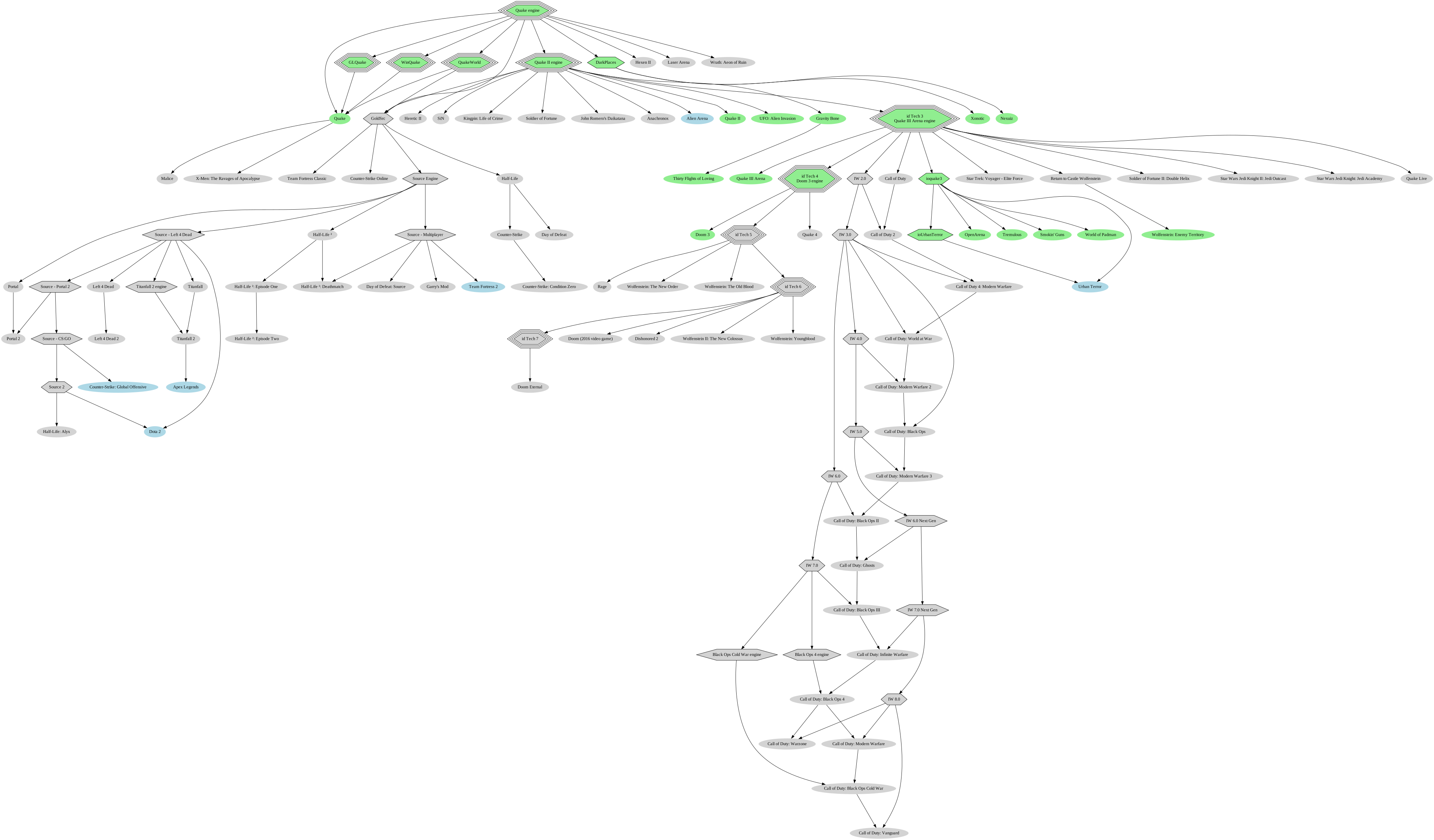
The foundations were technically weak and they started the reengineering process (DOTS) a bit late.
I've seen that before, with PalmOS and other tech stacks that were hacked together and kind of worked for a while until the competition caught up.
The zombie state can last a few years, but I am pretty sure there are cases where the whole thing can be saved with herculean effort.