Modern Indian housing in major Indian cities has done a complete 180 from these tried-and-tested architectural practices. The materials used seem to be deliberately chosen to maximize human misery. There's glass everywhere which, besides being impossible to keep clean in India's dusty summers, also retains heat and makes most housing unbearable without AC.
Then there are the designs themselves. Faux wood is everywhere, as are laser-carved patterns that collect dust. Spaces are designed to maximize square footage, ventillation and sunlight be damned.
The "builder floors" that dot cities like Delhi are an exercise in public ugliness and bad design.
Edit: An example of the kind of housing I'm talking about. Superficially "modern", but absolutely the wrong design for Indian weather:
Canada makes similar mistakes. People imitate California designs in a Canadian climate and then find that the building is uncomfortable, and expensive to heat and cool. In many cases, builders will actually reuse complete designs without modification. Just madness.
My parents recently moved to a similar building with huge glass windows (different part of the world). They ended up installing black mesh roller shades, and pretty much need to keep them down half the year, to keep out the heat. For all intents and purposes, they now dwell in darkness. That kind of architecture basically creates new problems, rather than solves them.
I have big black mesh roller shades over a pair of large windows, they are amazingly effective at keeping the room cooler (as long as they're on the outside!) I think it'd be fair to say that they don't make you 'dwell in darkness' as much as a solid wall would...
> I think it'd be fair to say that they don't make you 'dwell in darkness' as much as a solid wall would...
Especially if they are motorized. It's the only home automation thing that I actually find very useful in my home, which has huge glass windows, that I love.
I have a little process that checks the UV index level once an hour. If it's above 6 it closes them and if it's below 6 it opens them. I know UV index doesn't actually track temperature, etc. But it's a good enough proxy for the sun it up and it's bright. And it does a good job of keeping the windows unblocked during mornings and evenings.
In the example you give, there’s no way of knowing if it’s been properly designed for Indian climate per given budget constraints.
There appears to be windows on only 2 sides of the building, 1 of which is far enough inset to create significant shade.
Depending on what direction the building faces, this could in fact be optimal design for staying cool while still having windows.
Now, of course, the best design for staying cool would be an underground cave carved out of rock with no windows—-but is that really how we want to live?
There is no scalable home design that works without AC when temperatures regularly get to 100-120F with high humidity.
>Now, of course, the best design for staying cool would be an underground cave carved out of rock with no windows—-but is that really how we want to live?
Adding light and some ventilation is a lot less energy intensive than cooling
Not too deep because you know what's there.
I don't mean the balrog, rather infrastructure for water, sewage, etc. Granted that might not be the case on private property, and in India, but still. Where I live people sometimes cut underground power cables, water or nat gas.
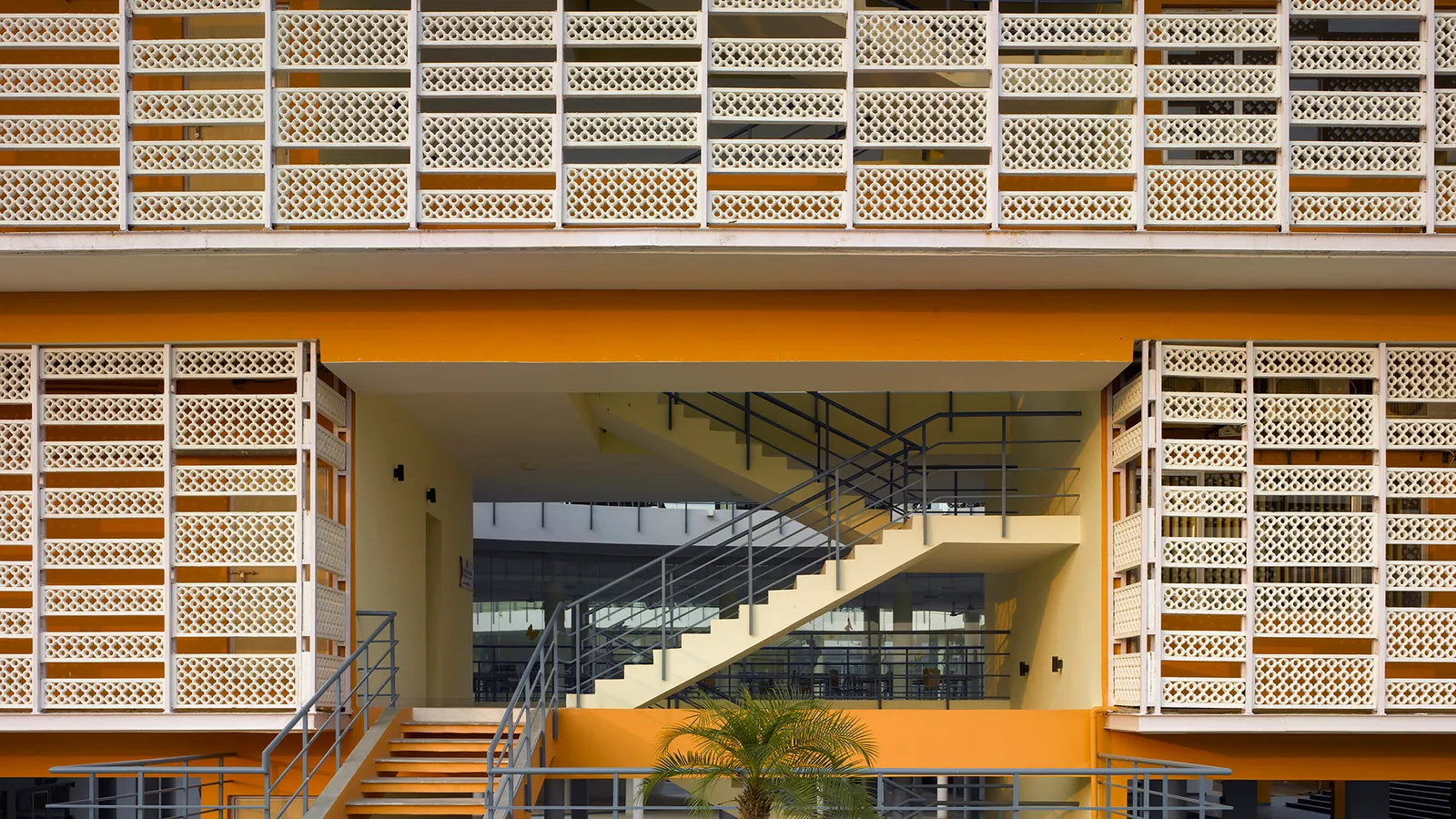
I think this facade [1] demonstrates a better way to maximize shade, along with windows that are normal-sized instead of floor-to-ceiling. It doesn't look "modern", but it's a lot more practical
> Faux wood is everywhere, as are laser-carved patterns that collect dust
To me this looks like the natural consequence of people not cleaning their own houses. Same thing with 3000sqft/300m^2 houses in the US for that matter.
The house that I grew up in India, has that lattice as part of the building. Used to be great when I was growing up as the house was on a raised foundation compared to surrounding houses, and we would get a nice breeze in the evenings. The neighborhood was not dense and we mostly had single family homes.
Now, because of the absence of zoning regulations, we have 4 story buildings - so there goes any natural light and ventilation and there is an epidemic of dengue because of mosquitoes.
And that lattice annoys me, will probably need to put a mesh there to keep out the mosquitoes.
> Jaali’s cooling feature relies on the Venturi effect in a similar way to an air conditioning unit. "When air passes through holes, it picks up velocity and penetrates afar. Due to the small apertures, air gets compressed and when released it gets cooler," says Pandya.
When the air passes through the holes, yes, it picks up velocity, but that velocity is lost immediately upon exiting so it can't penetrate further than if the restriction wasn't there. In fact it must lose some energy due to the restrictions so it will penetrate less and you can easily observe this when using a mosquito net in window.
Secondly the air is not compressed through the holes, the pressure actually drops as the speed increases. Unless I completely misunderstand the Venturi effect, in which case please correct me.
The purpose of the lattices is to let in air and light while restricting direct sunlight. That is important enough especially since it's passive, but shades are being used in modern buildings, it's not some lost art, and it is clearly nothing like AC. It's not even like modern ventilation or mobile shades which can let air only during the cool nights.
« One notable feature of the building is its application of a physics principle called the "stack effect", whereby the rotation angles of each brick in the jaali are designed to minimise solar radiation. »
As the air shrinks in volume (and as you say, speeds up) it goes up in temp. It dumps sone of that heat into the marble. So when it opens back up, it slows down and cools down. The material choice would seem to be very important. Marble and sandstone both have high thermal mass but low thermal conductivity.
> As the air shrinks in volume (and as you say, speeds up) it goes up in temp.
It does not shrink in volume, it does not compress, it only speeds up so the debit remains the same. If anything it would expand as an effect of the Venturi, because the pressure drops.
I was looking at a picture from the venturi in an AC loop where one side is higher because of the compressor and over restriction Yeah, venturi would seem to be a non-effect here.
I agree that the explanation given in the article seems wrong.
I think the correct way to reason is to consider the building as whole as a system.
There is pressure difference between two sides of the building, one in the sun and one in the shade. It seems that jaali is best understood as air flow diffuser. It reduces the overall air velocity flowing trough the building and decreases the pressure. It's a good at mixing air, thus temperature behind jaali is lower but not as much lower as it would be with solid sun shade.
Jaali probably just acts like an air shield (i.e. the air thrower above doors in shopping stores). This way you still get fresh air except lower rate of heat transfer.
We have this in our family home. Was not a fan of them because they collect all the dust but after reading this article they seem to have a very good use we never think about.
When I was a child I grew up on one these old homes with Jaali design and as family grew we added in few extension to the house with modern look and feel. During peak summer you can feel the difference in room temperatures in old vs new section of the homes. Jaali design essentially helps in partially blocking sun, you still get the light inside the home and it magnifies the surface area to loose all the heat very easily.
They also make it impossible to add air conditioning if I'm reading this right and can only really cool things down to the surrounding temperature (basically attempts to keep buildings from turning into greenhouses). Very cool but I don't see this being implemented anywhere where someone can afford AC
Using an airconditioner and lattice structures/jaali are not mutually exclusive.
As an example, if you consider large buildings like hotels that have an open central courtyard, the open spaces could use the lattice structures for cooling/circulation while the rooms, banquet/conference halls and other closed spaces can use airconditioners.
Since the lattices offer passive cooling, they can lower the overall energy bill.
Given the amount of traffic, street level noise, and air pollution in many Asian countries I don’t see this being implemented any time soon, in places where it matters.
Ceiling fans would also work really well, but similarly require openings in buildings. Now you only see them in traditional buildings (read: museums most often) because they were made with airflow in mind, before the age of AC.
People will prefer a hermetically sealed building because it’s the best escape from their own mess.
A shell within a shell also works. It’s common for tall building to have air gapped external cladding to reduce the need for cooling. There are significant trade offs around construction costs, views, and the need for cooling.
However, the savings can be very significant for more extreme designs.
"Jaali’s cooling feature relies on the Venturi effect in a similar way to an air conditioning unit. 'When air passes through holes, it picks up velocity and penetrates afar. Due to the small apertures, air gets compressed and when released it gets cooler,' says Pandya."
There’s no way holes are going to cool a building down like AC. The building is going to be similar to the outside it will just cut down on the greenhouse affect.
Nobody is saying that lattices are some magic solution that breaks the laws of thermodynamics and cool environments without expending energy.
It is an just an amplifier like radiator , to reduce the amount of HVAC you need . In 16th century they built only lattices because that’s all they had.
The suggestion is to use those ideas in modern design not copy paste the same designs.
The examples of modern buildings incorporating jaali all seem to use it too keep the exterior cool (and shaded), with the interior then further air-conditioned as necessary.
If I understood the article correctly, the temperature could be slightly lower than surrounding air sure to the venturi effect. At least that's what the article claimed, even though it provided no concrete numbers on its effectiveness
Basically these buildings are just the same temperature as the outside, all the time. No air sealing, no privacy, no noise isolation.
I could get the same result living in a garden shed, but I won't, because it sucks.
Because these are from an "exotic" location apparently they are worthy of an article in a Western publication that treats them like some kind of amazing eco-friendly cultural marvel, when really all they are is just the best people could do before they had modern technology.
Not the same temperature, it will not give you a differential like HVAC system can, but it can be substantially cooler than outside and in conjunction with lattices HVAC can be much cheaper as well.
the lattice basically increases surface area by a lot that increases cooling Same concept as a radiator .
The materials are also important , certain types of stone have desirable thermal properties especially the amount of heat they retain .
Instead of being close minded and think all things ancient/eastern are bad and useless (or all good either) why not incorporate the best of all ideas and make cooling efficient and cheaper .
Eco friendly cooling are not, they absolutely a cultural marvel, those intricate designs tell untold stories and a testament to human endeavor.
> Instead of being close minded and think all things ancient/eastern are bad and useless (or all good either) why not incorporate the best of all ideas and make cooling efficient and cheaper .
That just doesn't work. Modern climate control technology is fundamentally based on having homes that are insulated and sealed off from outside airflow. Lots and lots of effort has gone into that, and people spend a lot of time and money retrofitting older homes to achieve it. You can't combine that sort of stuff with lattice windows and free air transfer from outside.
Also, don't accuse people of being close-minded just because they know newer stuff is better than older stuff. That is definitely the case for climate control, and for home building in general. Don't buy into the trope of "ancient eastern wisdom" -- people who live in Asia certainly don't fall for that nonsense, and they build modern homes with air conditioning just like everyone else because it's better.
Shell within shell is perfectly valid design for buildings and is found in nature as well. I am not an architect, am sure there are better solutions out there beyond what I know.
Popularity is not a good measure of something is better.
There are many aspects of ventilation that are actively studied still , it by no means a solved problem, just look at heating in London Underground for real world modern problem .
Closed areas and Smooth surfaces with leas surface area are terrible for radiation and air cooling . Buildings are not static objects they are heat sources as well.
Insulation and ventilation are different concurrent problems , some places need both equally , some need a lot of insulation and less of cooling and some need other way around . There is no one universal solution.
You are right I shouldn’t have called it closed minded . I gave it a charitable reading , reading back once more it is definitely racist not just closed minded , the parent post also called it culturally inferior not just technically so.
Obviously a modern system is going to have better control and range over temperature, but it does come at a cost. According to the link from datameta the older techniques do have a measurable effect.
"Scientists have recorded a temperature difference of 16C (29F) between the outside and inside of the visitor centre, despite the many bodies regularly passing through."
I imagine the best systems are the ones that combine both ideas. Such as Apple Park:
"A Building That Breathes: Between each floor of the building is a canopy that juts out, mainly to protect employees from the intense California sun. Tucked within each canopy is a ventilation system that funnels air in and out of the building. Apparently Jobs, who was not a fan of air conditioning, wanted his employees to feel any passing breeze as if they were sitting outside. Through a variety of sensors, the building can maintain a temperature of 68 to 77 degrees Fahrenheit, all by using an intake and release of natural air."
Really interesting!
It reminds me of Majorcan shutters (in spanish persianas mallorquinas).
In Majorca/Minorca you cannot shut the windows when theres hot outside: humidity will make interiors as hot as the outside; but you can open the window while you have the shutter closed... and survive.
Probably in California there are some Majorcan shutters, too (Juniper Serra was from Majorca after all) ???
I think they're popular all across the Mediterranean, I've certainly seen them in Italy and Croatia.
Shutters are noticeably missing in areas in Northern Europe due to "never being hot enough", except... now they would be welcome.
For what are probably obvious reasons, this style of shutter is everywhere in the post-colonial tropics. Look at any heritage building in Hong Kong, Singapore, Hanoi, Nassau, Martinique…
I'm like 90% sure I've seen a similar article posted here, featuring middle-eastern or possible north-african/south-european buildings with this exact effect, predating these Indian ones by many centuries.
I dunno about the author, but for me "cool" means something like $temperature < 25C && $humidity < 60%.
No amount of ventilation is going to keep a building "cool" like that when there's a 49C (120F) heat wave outside as the article says. Or even 35C, if there's any humidity involved.
A large temple with thick stone walls, on the other hand, could remain substantially cooler than its surroundings through a couple of weeks of unusual heat wave, because it has a large thermal mass. That's an architectural style that we might actually want to emulate. Increasing ventilation probably isn't going to help, though, in that case.
I agree. It feels weird to attribute to cooling effect of the structure to the little holes and not to the thousands of tons of stone that can absorb heat. I just moved into an older building and it remains very cool. No jaali to be found, but plenty of old masonry walls.
My favorite nature-inspired architechtural design concept is based on termite mounds, which have built-in cooling due to their structure, and whose design appears quite similar to this traditional lattice approach:
> "The secret of this balance of solid strength with porosity lies in a two-layered architecture. A dense core provides strength and stability, while a porous shell surrounding the core allows ventilation."
This idea seems to be gaining traction, here's a new building in Vietnam designed on the termite mound concept which looks remarkably similar to the described traditional Indian lattices:
Traditional Indian architecture has separation between outer zone and inner zones with different walls and roofs. Basically outer walls and attic roofs can heat up (and cool down with airflow) while inner walls and roofs will remain cooler. Also, the traditional clay-brick walls are much thicker than today's concrete blocks. Those clay bricks have much higher heat capacity.
It's a neat technique, but there are some problems:
* Permanent architectural features to reduce sunlight absorption only make sense where its consistently hot, year round. In areas with cold winters, its not grate.
* Perforated walls offer very little privacy or protection from the environment, animals, or people.
* Cleaning and maintenance of these perforated walls requires more intricate and costly effort
>Perforated walls offer very little privacy or protection from the environment, animals, or people.
Not being able to seal and air condition these homes will kill a lot of people when "wet bulb" events start becoming commonplace. I'm thankful I live in a climate far from the equator where we get more of a dry heat.
>Application of the passive approach as a non-mechanical method is an effective technique to tackle high energy consumption as well as diminishing the destructive effects of buildings on the environment. Using passive cooling can lead to peak load reduction as well as peak load offset, diminishing the interior temperature fluctuation, maintaining indoor air temperature in a comfortable range which consequently reduces fossil fuel usage as well as decrease the greenhouse gas emission. In this study, using passive approach from the economic point of view was discussed. The competition between cost saving (owing to applying passive methods) and added cost (owing to the initial investment, maintenance and operation cost) can specify the usefulness and effectiveness of using passive techniques. In this regard, special points such as building function, ventilation requirements, sensible and latent heat gains, the ability of any technique to save energy, geographical location, user financial ability, initial investment, maintenance and operation cost, regional climate data should be taken into account. Literature review affirmed that owing to applying passive approaches in building, energy consumption is diminished by 8%–70% (using external shading), 37% (utilizing cool colored paints roof), 25% (Creating green space), 7.88% (construction of the prismatic building), 32%–100% (using vegetation-based wall), 50% (using PCM-base wall), 33% (incorporation of insulation into the wall), 10%–20% (building equipped with solar chimney), 25% (using radiative cooling system). From the economic viewpoint, it was found that through finding optimal passive approaches, life-cycle cost saving reached 52%.
Vernacular architecture is taught in 101 courses, but my experience in arch schools / grad programs in North America is they're too divorced from building science. Apart from checking LEED boxes / certification, it's risky / hard to justify remixing vernacular elements outside of prestige projects with big budget that can afford to do the modelling to spit out confident operating costs. Maybe when the software improves.
We either de-carbonize energy in which case air-conditioning doesn't contribute to CO2, or else we fail.
There is no world where we convince the vast majority people to forgo air-conditioning. Billions of people in India, China, and Africa want air-conditioning.
Decarbonizing the grid will be much easier if we have less of a "grid" to decarbonize. The article mentions this aspect, if you had cared to read it. Modern buildings can use this lattice to reduce the load on their air conditioners.
Although I do agree with you in principle. One of the lasting impressions I got from the early Covid lockdowns was that even though we stopped a good chunk of the world from driving to work, flying, running factories, etc., we didn't come close to reducing our energy use enough to prevent more warming. Those lockdowns were a huge exercise in "energy austerity", and they weren't enough.
De-carbonizing is also not going to save us. It is merely a mental panacea to keep the masses from panicking more. The carbon that was pumped into the atmosphere before our grandparents were born already guarantees climate change. We delude ourselves by thinking we can stop it in the next century with any action we take now. Not poisoning ourselves is a good idea and all, but it isn't going to stop the climate change that is already triggered.
I wonder how this would work in someplace like Ohio that's hot in the summers but cold in the winters. Would it make the home even colder in the winter? If so, is there some variation that works both ways?
I've heard of overhangs that block the sun in the summer when it's more directly overhead, but allow direct sunlight into the home in the winter when it's at more of an angle, so there are certainly some things that can be done.
> I've heard of overhangs that block the sun in the summer when it's more directly overhead, but allow direct sunlight into the home in the winter when it's at more of an angle, so there are certainly some things that can be done.
This is the best approach to take almost anywhere that experiences hot weather, which is almost anywhere these days. It works like a cowboy hat or an rice field worker's conical hat.
In addition to the overhangs, it's wise to minimize windows on the side of the building facing the nearest pole, both to reduce winter heat loss, and minimize summer heat gain. Conversely, the same house should put a reasonable (but not excessive) amount of glazing on the side facing the equator, to maximize winter solar heating.
The problem is often that the optimal placement of windows overhangs isn't possible due to existing orientation to the streets or other features.
> it's wise to minimize windows on the side of the building facing the poles, both to reduce winter heat loss, and minimize summer heat gain.
North-side should always be low-window, but south-side depends on levels of winter insolation. If there's a lot, then south-facing glazing, with a suitable overhang to block summer sun, and a large thermal mass right behind them, is very desirable for winter warming.
Updated my comment to clarify that I meant to minimize windows facing the nearest pole. In the southern hemisphere, you would minimize south-facing windows.
I'm extremely uncomfortable by 20° C. By 21° C, that's 3-showers-a-day for me.
I'm all for sustainable technology improvements, and this certainly appears to be a valuable tool for reducing AC costs, but I'm not on board with decreasing my quality of life in the process, so this isn't a replacement for AC by itself.
Hot and humid, but less so than much of India. I am working out the logistics of moving somewhere colder, freezing temps don't bother me because you can just keep adding more layers with no extra CO2. That doesn't work the other way around :(
Did you even read the article? It says the point of these techniques is to help reduce the usage of AC, not reduce it. If you can lower the amount of heat entering a building (which this lattice technique helps with), then you need to use your AC less.
Of course! See my comment above. Just remember that policy is shaped by the opinion of the general public, who, in America, overwhelmingly only read headlines, not full articles.
My criticism is with the headline. Imagine all the people in Florida and Texas who read the headline and immediately "nope" the whole idea. That's a poor headline for building consensus on the need for new architecture to reduce our collective carbon footprint.


Then there are the designs themselves. Faux wood is everywhere, as are laser-carved patterns that collect dust. Spaces are designed to maximize square footage, ventillation and sunlight be damned.
The "builder floors" that dot cities like Delhi are an exercise in public ugliness and bad design.
Edit: An example of the kind of housing I'm talking about. Superficially "modern", but absolutely the wrong design for Indian weather:
https://newprojects.99acres.com/projects/findahouse/findahou...