Hacker Newsnew | past | comments | ask | show | jobs | submitlogin
Ask HN: Seriously, steelman this please. 7,400 employees at Docusign?
159 points by tomcam on Sept 28, 2022 | hide | past | favorite | 161 comments
This article did not shock me at all but somehow looking up the numbers on Docusign made me wonder, seriously, and with all due respect: how would you get to 7,400 employees at Docusign? I literally can't do back-of-the-napkin calculations that make it plausible.

https://news.ycombinator.com/item?id=33010050


For SAAS companies that do B2B it's important to remember two arms of the company:

1. Sales -> You can hire a lot of sales people if they're generating enough business to cover their own salaries

2. Customer Support -> Big enterprise contracts generally have support written into them. Thus, for every enterprise customer Docusign may need anywhere from 0.1 -> 3 (or more) FTEs. If you price this right it's always worth it to keep growing the org this way.

Docusign has a lot of opportunities to upsell customers on legal services they provide.

You should also consider the scaling cost of internal support. For every 10 FTEs, add a manager. Also add on HR, accounting, janitorial, etc. Easilly 20% of the company might be these sorts of internal support roles.


Don’t forget that signing is primarily a legal activity. Every jurisdiction handle it differently, and it’s important to be able to articulate what your product can and can’t do. This was particularly relevant during the dark days of COVID lockdowns and quarantined, where those laws and practices were tested to their limits. They likely outsource a lot of that regional work, and do so on an ad hoc basis, but they still need knowledgeable people to coordinate it.


Isn't the user responsible for the "Docu" part and they only facilitate the "Sign" part?

Point being, it's up to the users to figure out if signatures on a digital platform will be legal or not in their jurisdiction. DocuSign probably has some fine print explicitly stating they're not responsible for improper use.


It's likely they still have to deal with law suits, at least until the judge rules on the fine print.

It wouldn't surprise me if they have legal/expert support for certain cases. The last thing you want is some dumb client losing a case that creates precedent which ruins your business model.


They do more than sign, they manage the process and lifecycle of agreements.

You can buy a turnkey loan solution for example from them.


They help you manage the workflow of documents. As say a car dealership using docusign, you still provide the documents and actually have to use their tools to make the workflows unless you pay them to help. I don’t think they offer to actually write the contracts. You’d hire a local attorney or just digitize what you already have. That’s been my experience after a couple enterprise level deployments. I could be wrong and we just didn’t need it.


I bet there are teams for consulting, solutions, and services. "Need help digitally transforming your blah blah blah with Docusign?"


Aren't sales people also heavily paid in commission? I.e. for a large part, you only pay if they bring in business?


For a lot of B2B SAAS which sells to enterprise, sales people can get decent salaries. An SDR (finds leads and books meetings) could get anywhere from 50-65k Base salary with commissions and Account Executives (AE, they do demos and close) could even get starting salaries of 100K plus. So yes, they get paid through commissions but at SAAS companies, they also get a decent base to start with. Ultimately though, the total comp. adds to the payroll and reduces profit regardless.


at any company the sales person will have a "base", but at none can they take it for very long. even in 100% commission roles if you make no sales you get what's called a draw check because it's illegal to pay less than minimum wage per hour worked


Lawyers likely make a large part of the organization too. At least compared to other similar size companies.


Does anyone actually directly employ janitorial staff these days?


I have been involved with companies with government security clearances and organizations simply worried about intellectual property theft. As a rule, the most serious of those organizations do not allow subcontractors free rein of the building, which janitors need.

(Edit: Yes, I am aware of some high profile failures.)


I think you can get subcontractors that specifically provide cleared janitors. (The same way that for example the NSA famously uses cleared contractors for things like IT.)

But anyway, Docusign surely isn't an example of such a company or agency.


Yes, NSA’s high profile failure with Booz Allen is a great example of why some things should not be outsourced.


But it’s the same clearance process and standard if you’re outsourced or not - they don’t do anything extra if you’re inside a service.


This has not been my experience. I was FSO for my organization. I was responsible for periodic training and internal audits. I have no way to know how well any other FSO or any other organization ran their periodic training and internal audits.

Yes, the check by the government is the same.


Is it? It's not like the various intelligence agencies haven't had their share of on-the-payroll moles.


In my own experience with such organizations, we were less worried about moles than by inconsistencies in vetting, training, and process.


Docusign is certainly managing many proprietary documents.

I agree that it is likely that they outsource like other organizations. I still don’t think it is a good idea.


I've worked in aerospace and chemical companies where there's all kinds of data restrictions etc and both contract the janitorial staff


As have I. The most serious are not outsourcing.


Aren't there companies specializing in providing top secret cleared service staff, such as janitors?


I found out yesterday that our facility management is employed with us. But we also handle seriously sensitive data.


> 1. Sales -> You can hire a lot of sales people if they're generating enough business to cover their own salaries

It won't be long before GPT-3 or its successors will be putting many people out of a sales or support job.


Funny to see how little value devs and engineers put on sales people. Enterprise software success depends highly on sales people. Startup success depends highly on marketing. At previous company, SAP flew the CEO and a few others to Monaco for the F1 race. Interesting to see we had SAP and PeopleSoft implemented at the company.


Yup. Devs like to think that sales people don't contribute real value and are basically just marketing, and that's true to a degree, but it's also true that sometimes the entire product doesn't contribute real value either. A senior dev building Uber/delivery clone #1745 run by VC funny money is "contributing" the same as a sales person, no matter how many frameworks and algorithms he uses. (Unless, of course, that algorithm is itself contributing to some efficiency in the deliveries.)


So the value the sales people provided was successfully bribing the executives.

You're not exactly wrong here, but many that's a kinda hilarious example. AI doesn't yet know how to operate in the grey area of not-quite-illegal bribery.


Why can't a computer program automatically buy tickets for F1 and send them to prospects?


How will it determine who gets the tickets? And which event is the most appropriate one for a given prospect? How will it know that the prospect is interested in the first place? Or available? Or worth wooing in this manner?


It could do that part. Making the decision about what to buy, how much of it, and for whom etc would be the types of non-trivial decisions you need your sales AI to make better than a person


The F1 tickets are about access. Your pal the sales dude buys you scotch and yaks about SAP.


You're not gonna replace people who make phone calls all day without something more or less indistinguishable from strong AI. Nobody wants robo-calls.


You don't need chatbot tech to be indistinguishable from strong AI, just indistinguishable from an average salesperson. Like babyshake, I firmly believe that this will happen one day. 10 years? 50 years?


FYI for you and other readers, sales is actually hard. Low barrier to entry followed by brutal survival of the fittest. Don't meet your quota? Fuck you, you're fired.

People who survive for decades of that aren't trivially replaced.


Or as was put to me once, sales managers have no problem firing people. And that includes people who just had the bad luck to have their supporter at some company leave and be replaced by someone who favors a competitor. Or a project just gets put on hold because of budgets. I suspect many developers wouldn't appreciate being evaluated every quarter in no small part on factors that they have at best limited influence over.


You underestimate future AI tech (from 10-50 years from today) even more than you think I underestimate sales skills. The tech will completely blow your mind away, and you don't even see it coming ;)


At that point why would you even have AI sales?

If this tech is going to be so amazing, it'll be better served by being a procurement/buyer system.

"Hey AI, what CRM system should I use [based on all the knowledge you have of my business already]?"


Azure chatbot: Dynamics E7


correct, no need for salespeople


I suggest you actually try and sell a product once before making this kind of prediction.


OK, sure, but handwaving enough, that's true for almost every job that exists today.


You seriously think a salesperson can be replaced by a chatbot?


I feel like both sides think this,

Engineer - Our company is so good word of mouth should be enough to bring in sales, if we need any more lets look to AI for a solution.

Sales - We bring in the money, all engineers do is cost the company money, we could probably run the app/develop the product on a skeleton crew, can't wait for AI to make those jobs obsolete!

Truth - Both engineers and sales are hugely successful to any companies strategy and AI isn't taking anyone's(engineer or sales) jobs not for a long time :)


As a sales guy, I can assure you we value the development of good product over all else. It makes our jobs a hundred times easier.


Yea, but at most companies that doesn’t mean valuing all the devs ;)


Some boring business book:

Successful businesses must have 3 Successful divisions: good product, good sales and good finance/admin.


Willing to make a bet on that?

GPT-3 is great at sounding coherent, but much worse at actually reliably solving problems. I absolutely see GPT-3 like things aiding with sales decks, but... it won't replace the sales person.

There's also a large component of enterprise sales having a "trust" component where you know your counterparts. You're not spending approval-worthy amounts of money after only having talked to a chat bot.


> GPT-3 is great at sounding coherent, but much worse at actually reliably solving problems. I absolutely see GPT-3 like things aiding with sales decks, but... it won't replace the sales person.

Also, if your competitors are using GPT-3 to solve customer problems, having an actual, intelligent human can be a formidable differentiator in terms of customer experience.


> I absolutely see GPT-3 like things aiding with sales decks, but... it won't replace the sales person.

If there's a sales person whose job is to tailor sales decks to use cases, you might replace them.

If a big sale takes a team of people to execute, maybe AI cuts a few of them off. Maybe the client is still talking to a real sales person when they need to, but that sales person is able to multiplex to more clients because the time they need to put into each is reduced.

I think people often miss this aspect of "X technology will make this job obsolete"; it isn't "that occupation no longer exists" as much as "far fewer of that occupation are now necessary to do the work", and that change can have meaningful economic impacts. Farriers, blacksmiths and calligraphers still exist, but their work is no longer core to the function of anyone's economy.


Correct. The last professions in the world to be automated will be salesperson, politician, and plumber.


as a salesperson, I can confidently say that the change will be on the buyer side that eliminates the need for most salespeople. salespeople are already getting less and less time with prospects. Studies show salespeople only influence about 5% of the buying process. What comes next is automating recommendations for software products based on specific needs, buying criteria, etc.


Politicians have been automated through a combination of polling data and lobbyist checks since B. Clinton.


Are you saying B Clinton is not a human?


Define human.


It depends what the meaning of the word “is” is.


I think sex workers are up there too. Similarly to a good salesperson, the skill and human touch will probably always be a differentiator compared to a machine/AI, leaving at least a niche market for humans.


Customer support is largely useless today and can be replaced by machine. It only exists because average (dumb) people tolerate a human customer service rep saying "I'm sorry but you're screwed" better than a web page saying it.

Salespeople says BS to sign you up, only vaguely coherent, backed by some basic database facts about the product/price, so GPT can handle that. Think about Donald Trump: Huge fan base of paying customers, barely distinguishable from a chatbot.


Clearly you have never done or received customer support in a b2b environment. It can be as valuable or even more than the product itself.


Doubt it. Companies have been using chatbots with NLP for years. This only occasionally works to refer customers with technical support questions to relevant knowledge base articles. Mostly they're just a waste of time. Enterprise customers tend to have more complex support issues.


Chatbots exist to waste time to divert calls. There’s a high probability you’ll give up and not bother calling.

Only a moron would put them in front of a sale.


It will happen the day humans stop having emotions. So, never. Humans buy with emotions whether we like it or not. Emotions require another human to talk to. You cannot "Product Led or AI led" your way out of complex purchases.


Think about how complex it is to develop AI that can understand and participate in a human conversation at only a basic level.

Now increase that complexity by orders of magnitude, since we're talking about the conversational skillset that a successful salesperson would have.

Everything is possible over a long enough timeline, but when AI is advanced enough to function as a successful salesperson, there will be a large number of other jobs that AI will also be "replacing".

In other words, the timeline for what you're predicting is much longer than you think it is.


In other words, the timeline for what you're predicting is much longer than you think it is

Indeed. So many people I knew, thought full self driving, any weather, any road, fully AI, would be here by 2015. Then 20.

I doubt we will have it before 2050.


you're assuming sales conversations will be necessary in the future. I do not think that will be true for most purchases. It is much easier to match buyers with the right product based on their buying criteria. This is what buyers want anyway.


Well, Facebook is pretty good at automated advertising.

Those YouTube ads featuring pitchmen/people could be replaced by perpsnalizedt deepfake for race/gender/style that fits the target.


I think you are confusing a call centre employee, who blind calls via auto dialing, and reads a script, with a sales person selling a COTS, and doing inside sales.

There is zero comparison to this and a facebook ad, or targeted marketing.


GPT-3 ain’t buying me a coffee. They’re not inviting me to their Christmas party either.


B2B sales are generally relationship based, even inside sales. I don’t see a chatbot developing a relationship with a human customer.


This engineer thinks good engineers are much more fungible than good salespeople. The engineer's output is worthless unless someone else can be convinced to pay for it. It will be more difficult to automate the sales function than the engineering function.


Per their latest annual report:

"As of January 31, 2022, we had 7,461 employees, of which approximately 67% were in sales, marketing and customer success, 20% in engineering, product development and customer operations and 13% in general and administrative. We had approximately 69% of our employees based in the U.S. and the remainder in international locations."


> 67% were in sales, marketing and customer success, 20% in engineering, product development and customer operations and 13% in general and administrative

Ratios like this are fairly common.

I think the confusion comes from engineers who look at a SaaS and assume it's mostly engineers like themselves. Engineering is a small portion of the headcount.

A lot of customer-related needs scale with the number of customers. Any company with a huge number of customers is going to have a lot of headcount related to dealing with customers.


I think the confusion comes from...

For some, the confusion comes from "wow, that's about half the headcount that Microsoft had when I started in the mid-90s, and MSFT was building, selling, and supporting Windows, Visual Studio, Office,..." Perhaps DocuSign's products are, in fact, about half of Microsoft's big three products, but of what I know of DocuSign it's still a big number to me.


Microsoft in the mid-90s outsourced the majority of sales and customer support to retailers and VARs. If you add up all the employees working to sell and support Microsoft products in external companies the total staffing was enormous. The same situation applied to their competitors like Novell.


I wasn't around then but is it possible that we have learned more about B2B SaaS since the mid-90s through trial and error? And the conclusion the industry has come to is Microsoft would have been better off at that time with more sellers and customer ops hires?


Microsoft always sold through the channel. There were probably a half million people selling Microsoft stuff in the 90s.


Population growth since 1995: 30%

Computer/Online service usage growth: a lot more!


How many programmers did Microsoft need for 1 million OS installs vs 1 billion? The reason software can be such a money maker is that the marginal unit costs are close to zero.


Why does Microsoft get to be evaluated in 1994? How many people are working on their OS right now?


I don't know the answer to either of those questions. But I don't think the economics of desktop OS distribution have changed all that much in the last 30 years. I'd imagine the marginal unit costs have gone from very cheap to basically nothing now that physical media is a rarity. If modern OSes take more development effort (which seems likely), I don't think that changes the economics.


I for one am on the QA team. No, I do not work at Microsoft or any of its partners. I just use their operating systems.


I bet there's some market analysis of SaaS companies showing how differently they can be run. I wonder if it's bimodal - SaaS with <10% sales headcount, and SaaS with >50% sales headcount.


I can't imagine a highly successful SaaS company being able to maintain a <10% headcount


B2B vs low-price B2C.

How many sales/support reps does your $5/month pay for?


Which highly successful SaaS company does exclusively low-price B2C?


> Any company with a huge number of customers is going to have a lot of headcount related to dealing with customers.

Unless you are Google, which is then again where a lot of people in engineering can get confused as most companies don't hate their users quite as much as Google ;P.


This is also where companies can save a ton of money if they develop tools that allow customer facing employees to do their jobs much more efficiently.


haha, like developing tools that allow remote document signing...


Eng team of 1,500 then, revenue of $1.4m per head


> Eng team of 1,500 then

Not quite. 1500 people in "Engineering, product development, and customer success", so not just engineering.


Right, so maybe 750 developers? If that? Some companies are heaver on product and customer success headcount than others, but I would not be shocked to find out they had quite a few less than 1000 developers and developer managers.


That's 300 5-person teams, seems like still a lot.


all the heads create value


That is still mind blowing.

1500 developers for a click to sign platform? Competitors have done it with 1% of that or less.


I've been impressed by Docusign the few times I've had to use it. And I generally hate 95% of the software I come across. Everything seemed to snap into place, was perfectly intuitive. That stuff is easy to get wrong, as evidenced by all the crap out there.


It's not managed to annoy me, which is quite impressive. I never really considered Docusign anything special for usability, until your comment, but that's because it gets out of your road enough not to notice it.


And to their credit, I've been able to sign documents on Linux via Firefox without hassle. Half the time, some shitty SaaS apps will just sniff my user agent and block me.


And it may be worth noting that the alternative is often to go physically into an office someplace or get various notorizations or Medallion Signatures through your bank.


I was suspicious of the legality when I first got asked to sign, but I assume a legal team makes up a part of such a large workforce.


They do substantially more than the click-to-sign part. ID verification, contract management system, electronic notarization, APIs for automation of the whole thing, mobile apps...


Competitors have also done it with 1% of their revenue or less.


20% of 7,461 is still 1,492.2 employees, which sounds like a huge number.


I wonder what the difference between "customer success" and "customer operations" is here.


"Customer operations" is actually "customer success operations" -- it's the non-customer facing part of sales and support - the IT systems they use.

"Success" is just a a smarmy word for "sales and support".


In a very crude way, sales is about landing new deals or expanding. Customer success is about securing renewals for existing customer and increase adoption, prevent churn. It is a post-sales role.


customer success is probably the long term, proactive activities: keep the customer happy, manage renewals, be proactive.

customer operations is probably the short term customer interactions: support tickets, integration support, help desk, etc.


IIRC (It's been a while since I've worked with their teams) Customer Success was handled by the 'integration support' at Docusign.

If I -also- recall, When I did an Auth0 integration (a few years before that) I worked with a similar 'Customer Success' specialist while evaluating for an integration.

I think this is the trade-off that's happening; By putting integration support under a 'marketing' budget rather than a 'support' budget, it allows for a happier adopting customer base.

I must add however; those examples stand out to me not because it was 'sales-y' but because they were extremely memorable times of a vendor team working very hard to lead our teams into a pit of success. The best analogy I can think of is the difference between someone on a call giving a vague phrase you have to search through API docs for, vs a direct link to documentation complete with verbose-yet-sane examples.


Customer success: Churnbusters

Customer operations: ?? No idea never heard the term


One gets paid big sales commission bucks and the other does the actual work and is told "we can't afford a raise this year"


Unfortunately those numbers only increased my confusion. The breakdown of that 67% as baffling to me


One common driver of headcount is enterprise sales and support. Once you charge at least $75,000/year, you need to put salespeople on planes, you need to provide actual tech support, and (unless you're disciplined and lucky) you end up with hundreds of features that are only used by one or two big customers each.

Enterprise software is fundamentally a whole different beast. Customers will write big checks, but they expect a lot of different things in return for that money.

I don't know whether this applies to DocuSign.


You've described my company to a T. We aren't even that big and our customer service, sales, and marketing department make up about 80% of our workforce (even though we are SAAS).


It's quite easy to figure out if you look at their annual report, for example. [1]

Literally the first two pages of content explain, emphasis mine:

> To address this opportunity, our sales and marketing strategy focuses on businesses at all scales, from global enterprise to local very small businesses (“VSBs”). We rely on our direct sales force and partnerships to sell to enterprises and commercial businesses, and our web-based self-service channel to sell to VSBs, which is the most cost-effective way to reach our smallest customers.

> Hundreds of integrations with other mainstream systems where work gets done, such as applications offered by Google, Microsoft, Oracle, Salesforce, SAP, and Workday.

> Globally adopted. Our expertise in electronic signature and other agreement technologies is truly global. This is key, given that different regions have different laws, standards and cultural norms. We assist multiple parties in different jurisdictions to complete agreements and other documents in a legally valid manner

> Vertical offerings. We offer enhanced solutions tailored to particular industries, such as financial services, real estate, life sciences, and government. In some cases, these may be variants of a product like DocuSign eSignature —for example, our additional DocuSign eSignature options for assisting with compliance with U.S. Food and Drug Administration regulations. In other cases, it may be a distinct product for an industry, such as Rooms for Real Estate, which includes task management, templates, and workflow for real estate transactions.

You can see from their expenses that they spend two and a half times as much on sales and marketing than they do on research and development.

It's very easy to imagine how you could need 2,000 engineers to build and support e.g. 500 different integrations and 50 industry-specific solutions, all of which need to be actively maintained for compatibility. And then an even larger salesforce that is selling to companies literally across the globe. Not to mention the lawyers and legal analysts attached to all of those.

Docusign isn't a mere PDF viewer computer program, it's a business that provides ironclad legal services that are vetted by lawyers and guaranteed for your industry's specific legal needs in the countries where you operate.

[1] https://s22.q4cdn.com/408980645/files/doc_financials/2022/ar...


I have no horse in this race other than being a Docusign enterprise HIPAA plan customer for my org of ~150 people, but: IME Docusign is absolutely at the tiptop of product quality, documentation, and service for any SAAS company I've ever used in the last 16 years. Whether that requires 0.74, 7.4, or 7.4 million employees is up to them.


The rest of the internet when workers get laid off:

Those poor workers, I hope they'll be able to find something new and provide for their families.

Hacker news:

Good, that company had too many employees anyway.

\s in case it's not obvious


Unemployment is that foreign to tech people.


While ironically barreling towards many of us at high speed. White collar tech workers are likely to face the worst of the layoffs in this round of economic troubles.


Yup. The days of $500k for doing nothing are ending soon.


Knowing a few people there work there... They have teams that work with specific customers to customize their product. I'm guessing a large client like Google could have a team of 100+ folks alone working on that client (across sales, tech, support).

The other thing is that they do stuff outside of just signing documents. They are a software company. They work in the enterprise space too. That ends up pulling in a ton of people to support those large clients.

Could they cut a lot of folks? Sure. But just about every large company could.


They're mostly sales, marketing, and customer service. Engineering is mostly supporting integrations with every arbitrary platform and CRM they can possible handle.


There is no limit to how high headcount can go, for virtually any business, unless something stops it. That doesn't mean anyone is intentionally padding the rolls, either. There is a certain momentum, as more people requires more supervisors and more support and more support for the support. 7400 people have a lot of company computers/IT, human resources requirements, payroll and accounting, etc. More people "requires" more people, in an ever-increasing spiral of hiring...until suddenly there is a hard stop that requires it to not increase, or even decrease.

I have witnessed this in corporate, startup, university, and governmental organizations, so it's not much to do with the task to be done. More people requires more people, until and unless something else requires that there be less people instead.

For Docusign, we have apparently just encountered that "something else".


I am always amazed when I hear company x laid off 600 workers and I"m like, "how did they have that many people working there?" I know it is probably sales and stuff but it it still seems unreal.

I've never had an office job and so it is like some kind of urban legend for me (Like I grew up in the country so I never knew anyone that actually went to summer camp, so I thought it was a fake thing made up for movies and tv.) Even though I'm nearly 50 I still relate to that tiktok of the woman asking what people do in an office all day https://www.tiktok.com/@mads.ringswaldegan/video/70920553756...


For reference, I've worked in companies of 500-1000 total employees where the companies designed, manufactured, sold and dealt with regulators all for things like artificial hearts (lvads), surgical robotics systems, etc. How is docusign 10x mor complicated?


In my experience if the "what the company does" headline seems too trivial then you have to dig deeper to understand what they're really doing. Business at scale tends to have fractal-like complexity and a lot of the work goes into fighting entropy rather than building the really obvious customer-visible stuff. See also why Uber's app is almost 400MB or why Twitter has 7k employees. On the other hand Weyerhaeuser manages millions of acres of land on only around 2k employees. Always in the details.


DocuSign did ~$2.4B annual revenue [1].

So each employee generates ~$320k annual revenue ($2.4B / 7,400), which sounds about right.

SaaS companies typically do low $100,000s per employee per year.

[1] https://www.docusign.com/press-releases/docusign-announces-f...


I feel the same way about most big corporations. Tech companies are not immune. I had a FB recruiter once brag to me about their Messenger team occupying a couple floors in Seattle and a couple floors in Menlo Park. Holy hell, what do you do on a project like Messenger with that many devs??


Countries, languages, fonts, internet speeds, 10 different platforms, abuse, scaling, infrastructure, testing, etc.


Scaling is likely to be the biggest problem, not app development.


They should just use Kubernetes™.


Is there going to be a flip on kubernetes like we saw with the mongo hype from 10 years ago? It seems overkill for so many things.


Look for yourself i guess? (EDIT: need to be logged in)

https://www.linkedin.com/search/results/people/?currentCompa...

'DocuSign' is a company and a product. The scope of the company is much greater than the product. I wouldn't guess less than 3000 for sure.


What’s at that link? It just redirects me to /signup/cold-join.


sorry you probably need to be logged in.

it's a canned search to people saying they currently work at DocuSign (6300 results iirc)


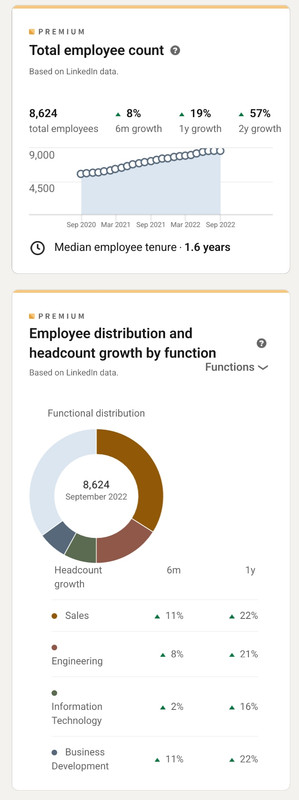
The LinkedIn Premium Insights section for Docusign shows almost 9k employees with this distribution:

https://i.postimg.cc/DZKS1vK6/Screenshot-2022-09-28-23-18-57...


What to recalibrate on, is that this is what a well funded $580 million revenue per quarter org looks like. You could certainly build a leaner org, with just 50 engineers, and way fewer features, but it's not going to be the industry stronghold that DocuSign is, not without some sort of competitive advantage (like when the Internet was new and you're competing as against companies that haven't digitized yet, but even then).


What does "steelman" mean in this context?


It's the opposite of strawman.

A strawman argument is a weak argument to justify a position you disagree with; its purpose is rhetorical: It's meant to make your position look strong to onlookers (and perhaps to yourself).

A steelman argument is the strongest possible argument you can come up with to justify a position you disagree with; its meant to help you find the truth by taking seriously the people who disagree with you.

OP is using the word slightly differently than normal, in that the position OP disagrees with here is, "Docusign needs 7,400 employees". A strawman would be, "Docusign needs 7,400 employees because it needs to show the stock market that it's a serious company" -- weak and easy to demonstrate that it's stupid. A steelman would be, "Docusign actually needs that many sales people and customer service reps."


It might mean "reinforce this argument/provide evidence for this", per https://constantrenewal.com/steel-man

From the context, it might also mean "rebut this as strongly as possible", "criticize this" or "defuse this argument".

It's unfamiliar wording to me as well. Does anyone have a rough etymology of "steelman" as a verb?


I think steelman is derived as the opposite of strawman. Taken literally, something made from straw is weak, and something made from steel is strong.

A strawman is an imaginary opponent who is easy to defeat. Like a scarecrow (a human-like figure stuffed with straw, meant to scare off birds from crops) which would be easy to defeat because it doesn't fight back when attacked.


Basically, it means "explain".

The connotation is the opposite of straw-man, so OP wants people to start from the assumption that it's true they need all those 7,400 employees, and explain why this would be the case. OP is not looking for cynical explanations such as that they only have so many employees due to incompetence.


"Explain" was the only possibility I came up with and was wondering how on earth OP got an autocomplete error to the word "steelman".

What a grossly unnecessary word.


Sometimes, it's just marketing, sales, HR and support. For a B2B, these divisions scale almost linearly with number of paid customers.


Have a read of David Grabber’s essay “On the phenomenon of Bullshit Jobs”, it explains this phenomenon quite well.


Products get complicated when you're trying to be #1 in the world.

It might take you a few months to slap together your MPV with a couple of devs, but several years later you need a 10 person team to work full time on the location autocomplete function because having your location autocomplete be 10% better than a competitor makes you millions of dollars.


Has docusign become what google has to search? Like I say to my insurance agent, “do I need to docusign something”?


Today I spoke with an older gentleman on the phone who said "let me give you my Gmail" and proceeded to give me an icloud.com address. Twenty minutes later a young coworker asked if the WiFi was down -- but everything in our office is ethernet wired. I am still processing this odd feeling of being in a generational bubble when it comes to avoiding tech eponyms (although I am certainly guilty of asking for a kleenex or calling my slow cooker a crock pot).


Imagine they operate in 150 countries and have 50 team members for each doing sales and support and outreach. It still seems like a lot but being international does add a lot of jobs


I’d assume a large chunk of them are in the field. Having a worldwide network of sales teams, both technical, nontechnical, and in between adds up.


I think there is also certain amount location specific regulatory and marketing work.


They don't have 7,400 engineers, if that is what you were thinking.


That’s mostly sales people.


9% layoff... ~666+ folks. Sad.


wonder what the type of roles are (sales / support) vs eng


This is like still asking why any competent organization still installs adobe acrobat reader by default on like every pc, and has to subsequently patch it every 2 weeks when it has exploits found still after ~25 years. Flash just finally died, and even then organizations turn to pirate builds to support ancient enterprise shitware still in use today.


Large companies have lots of employees not because they need them, but because they can. Many of the people who are good at leadership happen to like empire building and having reports. Every employee in a company is also an evangelist and a marketer, without even trying. Everyone answers the question "where do you work." Having lots of employees gives you slack, and it's easy to get rid of the slack with layoffs.


The economy today is more competitive than it's ever been. Hiring lots of unneeded employees is one of the easiest ways to obliterate your entire profit margin -- you'll go out of business and your competitors will eat your lunch.

So no, there is absolutely no truth whatsoever to your statement. Of course companies make mistakes and overhire sometimes, just like they make mistakes and underhire sometimes. Nobody can estimate future headcount needs perfectly without a crystal ball.

But the idea that companies are just hiring extra people "because they can" in order to "build empires" and "have reports" is one of the most nonsensical things I've ever heard. And I say this having worked at multiple large companies.


> But the idea that companies are just hiring extra people "because they can" in order to "build empires" and "have reports" is one of the most nonsensical things I've ever heard.

This definitely happens, I'm not saying that is the case here, but to dismiss it outright is pretty nonsensical in my view. Obviously it's not the "company" strategy to hire people and waste money, but company incentives and individual incentives start diverging very quickly in large cash flush companies.

The best thing for the company isn't necessarily the best thing for an individual to get promoted. I have definitely worked on projects that were entirely pointless and only existed to "use up resources" and justify hiring more. Bigger teams require more levels of middle management which results in promotions.

Again, not saying this is the case here.


I have personally seen empire building at companies as early as series B. It definitely happens, especially in the weird VC ecosystem where raising the next round is entirely dependent on revenue growth rather than profitability, which is always just assumed will come eventually with scale.


While I agree with you, I've also seen some crazy stuff that was hard to process for me, and I personally had to burn a lot of cash just because we were assigned it.


Right, and what that slack can mean is if SHTF then they can throw a bunch of people at the problem. Doesn't matter if most of those people are idiots because the point isn't even to solve the problem per se but for responsibility to be evenly distributed.


This only works if incumbent is immune from competition due to regulatory capture and other roadblocks for new entrants. eg: healthinsurance cartels.


Guidelines | FAQ | Lists | API | Security | Legal | Apply to YC | Contact

Search: