A lot of people unfortunately subscribe to the Malthusian ideology that all problems are caused by overpopulation. In fact, I'm pleasantly surprised when I meet someone who does not believe that overpopulation is the cause of most of the world's ills.
Malthusians have been predicting gloom and doom for years, and yet, continuously been proven wrong.
Anyone who believes otherwise has usually just not actually read what Malthus wrote in his books. His main hypothesis has at least been rejected for the time periods concerned, as the food supply has vastly outgrown population growth. Now, that doesn't mean everyone has food, but it does mean that the human population as a whole has an overabundance, quite contrary to what he predicted would happen.
At current population growth rates (exponential), within 10,000 years the number of human bodies would be expanding faster than our light cone (polynomial).
Population growth is not constant, further more the rate of growth itself has slowed down, and there is nothing to show that the slowdown won't continue, but lots of evidence that it will.
So population can continue to grow unchecked without stressing resources?
Where are you hiding your storehouse of infinite supply??
You're going to be very rich when the fossil fuels run out, oil for plastics becomes a luxury, when heavy metals relied on for batteries and magnets get more scarce, when water tables fall even lower, as helium runs low, ...
But no of course more and more people demanding all these things and ever increasing power usage can't possible reduce per capita availability?!?
The resources are created by the population. Metals are infinitely recyclable. So is water (distribution is the problem, not existence, and distribution can be solved if you have people who need it and are willing to do the work).
You don't need oil to make plastic - you can literally make it out of air (although it's harder, all the atoms necessary are in air).
All types of energy are more or less interchangeable, If one runs out, switch to a different one.
Animals use resources they find. Humans create those resources.
Yes but at some point there will be a physical limit. Earth's energy income will always be limited by the Sun's energy output. So no, not infinitely. (I imagine making plastic out of air would take a lot of energy.)
Before you tell me how much energy the Earth gets compared to how much we use, I'm going to pre-emptively reply "Exponential growth".
> I imagine making plastic out of air would take a lot of energy.
Not much more than you are otherwise loosing by using the oil instead of burning it. The hard part is getting carbon - not a lot of CO2 in the air.
> I'm going to pre-emptively reply "Exponential growth".
But we are not having exponential population growth right now. And even if we were, the universe is big REALLY big, stupendously unimaginably big. Even just the Earth is enormous, and we are nowhere close to filling it up.
How do you know? No one knows if the universe is infinite or not. And even exponential growth takes time - if it takes longer than the heat death of the universe (assuming a finite universe in both time and space) to fill it up, then it doesn't matter if it's exponential.
And to bring things back to this earth, this isn't going to be a problem for such a long time that predicting anything whatsoever about it is futile.
> Earth's energy income will always be limited by the Sun's energy output.
This seems to discount tidal, wind, and geothermal energy sources. Wearable devices that capture kinetic movements are a possibility too. As technology progresses, efficiency increases.
While what you're saying seems theoretically possible, it also seems a long way off (perhaps several millennia).
I'm often shocked at how people think history started at some point in the last 200 years.
Malthus was completely right and all the historical data we've been able to gather has validated his views, going back tens of thousands of years. The exception is post agricultural revolution, meaning the last 150 years, which might as well be a rounding error. It won't last.
Malthus was right: population is limited by food supply and any increase in food supply results ultimately in a higher population with a roughly constant standard of living.
> Malthus was right: population is limited by food supply and any increase in food supply results ultimately in a higher population with a roughly constant standard of living.
That's the funniest thing I've read in a long time.
You're asserting that we have roughly the same standard of living as people 200 years ago? 1000 years ago? 10,000 years ago?
Well, that kinda depends on how you define standard of living of course. We live very different and longer lives today as opposed to 200 or 1000 years ago. But on a basic day-to-day level, do you think you live a significantly happier and more fulfilling live than a random someone from a 1000 years ago?
Yes. This is so indisputably true I wonder how you can possibly think otherwise.
Even putting aside what must be something like 30 or 40 years worth of life expectancy at birth, and probably a decade or so of life expectancy as a 20-something, the median inhabitant of Earth a thousand years ago was engaged in backbreaking labor from sunrise to sunset, ate an unvaried, subsistence diet and was almost completely illiterate.
The current median inhabitant might be working in a Foxconn factory, but he or she has massive health and lifestyle advantages over his or her 1000 AD counterpart.
I was under the impression though that the 30-40 years average life expectancy is commonly misunderstood?
The mean life expectancy at birth might well have been 35 years but that's dragged down by massive infant and child mortality in the first 5 years of life - if you made it to adulthood, you had a reasonable chance of making it to 60.
I'm not sure claims about a topic such as happiness can ever be "indisputably" true.
Would you not even entertain the possibility that your "median inhabitant 1000 years ago" was actually quite happy with her unvaried subsistence diet, since it was a little bit more varied than her that of her poorer neighbour, and not much less varied than her much richer cousin's?
I doubt he would feel unhappy or unfulfilled for being illiterate - in his sphere of existence, what would he have read? To whom would he have written? Do you feel constantly unfulfilled though being unable to communicate with dolphins, or through being unable to interpret Tibetan Prayer Flags, or (perhaps more topically) through not regularly listening to oral poetry passed down from bard to bard? I suspect not - because you have no expectation of being able to do these things.
Currently, the (exponential) economic growth is tied to an ever growing consumption of resources, some of which are not renewable.
Malthus will ultimately be proven right unless we abandon growth or manage to dissociate it from resource consumption.
The first solution won't happen (prisoner's dilemma), and the second one is far on the horizon.
--
Edit: I knew that this post would not be popular, but I would like to hear a rebuttal to my argument, rather than getting downvotes (two at the time of writing).
The first one won't happen because it is good for literally no one. That's not prisoners dilemma. That's not even a dilemma.
The second one is happening full speed and has happened throughout the history of humanity. If you'd looked at wood usage 200 years ago, we looked doomed. If you'd looked at whale oil around the turn of the last century, it was all over.
We're shaking off oil now. It's taking a while, but every time the price of oil goes up, the profit for replacing it gets higher. 100 years from now, our 20 billion descendants will have more than enough of this curious mineral oil stuff for whatever archaic activities such might be used for then.
Past performance is no guarantee for future results. Other civilizations have failed in the past for mismanaging resources.
Your argument optimistically assumes that we'll be able to cope with the environmental changes that our activity is causing. Supply is only one part of the equation. For example, our CO_2 emissions, whether or not they cause global warming (that's mostly controversial in the US AFAIK), are causing ocean acidification, which could have a massive impact on marine life.
In dynamic systems as complex as the earth, tipping points are impossible to predict. That being said, we've never been pushing as hard for one.
Regarding growth, I have a hard time understanding how an exponential growth of our activity can be sustainable, especially in terms of energy requirements, which should be proportional (AFAIK). I believe that the current system is tautological. We need growth to sustain growth, but it hardly benefits people anymore. Wealth and happiness are related up to a point we reached in western countries in the 1960's IIRC. And after the last downturn, the economy restarted, but it didn't bring the jobs back.
I hope that there are alternative economic models. That's why I was talking about the prisoner's dilemma. I think that we're stuck on a bandwagon in a headlong rush.
I know that I'm very pessimistic about this, but I'm genuinely concerned. I can only hope I'm wrong.
Wealth and happiness are related up to a point we reached in western countries in the 1960's IIRC.
I think you're confusing absolute well-being with emotional satisfaction. The latter is often relative: Humans judge themselves in comparison to others, and are often happiest when they perceive themselves to be at the top of the pile. No amount of wealth is likely to change that. As our more "basic" needs of food, health and shelter are increasingly easy to acquire, yes, we'll focus more on that kind of emotional satisfaction.
But again, it's a relative phenomenon. If you think you'd be just as happy after being transported to the 1960's as you are today, I think you're fooling yourself. You'd miss all sort of features of the present day that our massively greater wealth has facilitated (and you'd miss a few years of life expectancy, too). Your absolute well-being is almost certainly much higher, and while that might not lead to emotional satisfaction, it's certainly worth pursuing. Better to be Socrates dissatisfied...
Objective well-being is an oxymoron. You can take all the objective indicators that you want, when it comes to happiness, subjectivity trumps them. Try to convinced someone undergoing depression that he's got everything to be happy...
> Better to be Socrates dissatisfied...
That quote refers to intellectual curiosity, not material wealth.
What new energy source are you relying on to support such an 'optimistic' prediction. What's going to replace plastics? What are you going to feed your 20 billion?
I can sort of see this working if fusion can be made to work in the next few years. But for the sake of the rest of the eco-system I hope man doesnt get anywhere near to that population.
How about solar satellites beaming energy down to the earth. We get hit by a very minor amount of sunlight from the sun.
Only 0.000000724654% of it reaches the Earth.
That’s 7.24654 billionths of the Sun’s total light.
the earth receives about 274 million gigawatt-years of solar energy
Put another way, the solar energy hitting the earth exceeds the total energy consumed by humanity by a factor of over 20,000 times.
And thats only only 0.000000724654% of the suns output. Now once we start harvesting our relatively unlimited power source food will no longer be a problem. Build 100 story greenhouse's etc.
I am hardly concerned about our future growth, considering we now have plans to start mining bodys in space. Perfect launch spot for providing our future energy needs. In fact I wouldn't be supprised if the energy is the main factor in planetary resources future plan to add trillions of dollars to the gdp.
>considering we now have plans to start mining bod[ie]s in space //
We need new resources in the next couple of decades (at the outside IMO, ie eariler would be better). Do you realistically see us harvesting a varied collection of minerals from space in that sort of time-scale.
If we stop using oil for fuel, there's plenty left for plastics. Oh, and carbon fibre is promising.
> What are you going to feed your 20 billion?
Food. There's plenty of unused room for it, and even then, there's hydroponics. Solve desalination, or hook up a cheap abundant energy source to what we already have, and there's even more room.
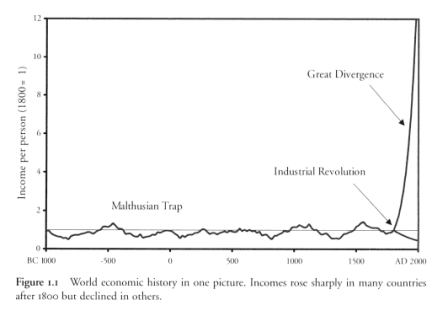
The book I referenced basically says that western civilization is an aberration caused by a unique set of characteristics, and that the vast majority of people in the world still live in subsistence conditions. Also that the west could easily slip back into those conditions.
The book says that many 3rd world countries are in a "Malthusian trap" - any increase in income levels results in a population increase that overwhelms the higher income. Bangladesh is a good example.
Up until 1800, Malthus was spot-on -- any advance in technology that was greeted by population increase would snap back to an equilibrium, with war|disease|hunger inflicting the correction. Gregory Clarke goes into great detail, with statistics on caloric consumption, lifestyle, etc.. that show that the average person at the pre-dawn of the industrial revolution did not experience conditions much more favorable than those of Roman times.
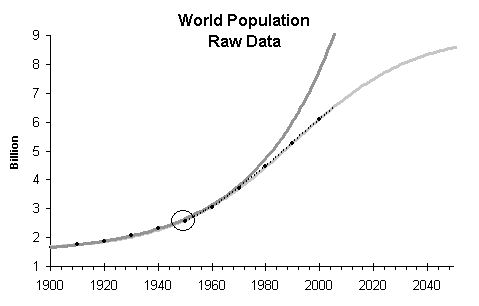
Malthus thinks that population grows like the dark gray line in [0]. Verhulst, and pretty much everyone else who has studied population dynamics [1], thinks population grows like the light gray line (though perhaps with more complexity.) Notice the actual population data following the light gray line.
At the simplest level, Malthus predicted that the population would outpace food production by the mid 19th century. So, on that level, he’s objectively wrong.
The main problems are the assumption that food production grows linearly and that population grows geometrically. For food production, scientific advances have kept food production growing far faster than linear. With future advances in technology, I could believe a 10x increase in food production in my lifetime. No one is predicting a population of 70 billion any time soon.
Also, the population isn’t growing geometrically. For the trivial answer, the growth has been more exponential. However, there have again been scientific advancements that Malthus simply couldn’t have forseen. Effective birth control keeps the population count lower. The switch from agrarian to urban culture has eliminated most of the advantages of producing large families and heavily rewarded producing smaller ones. In terms of hard facts, the world population growth rate has been declining since 1963. The UN’s medium projection of population growth predicts a population downturn by 2050.
At the basest level, he was right that the population can’t grow indefinitely. However, most claims that are more specific than that haven’t panned out.
So he was wrong because he had a too narrow view of the problem. I live in China, overpopulation means something here but even then any plane trip over any part of the world will show you, if washe weather allows, that humanity is not the cancer some describe.there is still plenty of room.