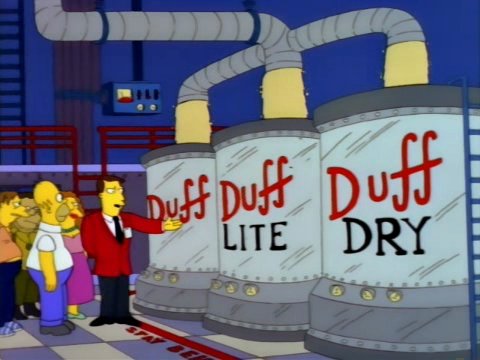
Niels Bohr would have approved of this. After all, he lived in a house which was linked to the Carlsberg brewery across town by his own private beer pipeline as well. The house -and lifetime supply of beer- was offered to him by the brewery after he won the Nobel prize in Physics: http://www.forbes.com/sites/alexknapp/2012/11/28/for-winning...
"In the past, there were two big Breweries in Copenhagen. Carlsberg and Tuborg. Carlsberg supported the sciences and Tuborg supported the arts. So, if you were a well known scientist, Carlsberg gave you free beer and if you were a well known artist, Tuborg gave you free beer."
---
"The house that Niels Bohr lived in was called the Carlsberg Honor Residence (Carlsbergs Æresbolig), and was the home of people deemed worthy from 1914 to 1995, of which Niels Bohr was the most well known (he lived there 1932 to 1965).
Before Bohr it was the home of Danish philosopher Harald Høffding (he lived there 1914-1931), and after Bohr it was the home of the archaeologist Johannes Brøndsted (1963-1965), astronomer Bengt Strømgren (1967-1986), and professor in East-Asian languags Søren Egerod (1988-1995). Egerod was the last person to live there, and it is now the Carlsberg Academy."
I've wondered: Instead of drone delivery, why not use underground conveyer belts for delivery in communities with sufficient population density. Instead of delivery trucks burning carbon and adding traffic, and people carrying packages to and from them, deliveries could be loaded onto the conveyer system and routed to their destinations.
Imagine Manhattan with no more delivery trucks and all the deliveries, every day, for office buildings and apartment buildings being conveyed directly to their basements (and maybe even to an elevator, which dumps the packages on the appropriate floor).
The deliveries could be the mail and packages we are accustomed to now, but also anything else from one building to another intra-city, b2b, b2c, or c2c: Carryout meals (or a meal you made for your friend), groceries and drugs (especially good for people too ill to go out), a computer to be repaired, the ISP could send a replacement router, the papers you need from the office, a substitute for intra-city mail, boxes to UPS/Fedex/etc -- anything could be delivered within hours (though I might be overestimating how efficiently a network with so many nodes could route).
Perhaps it would be too costly, but building a conveyer belt under someplace as dense as Manhattan seems potentially cost-effective for all the benefits. And again, perhaps I'm underestimating the complexity of a network with that many nodes.
I realize this is a bit of blue sky thinking, and I know nothing of such technology. And I'm pretending that there are no political issues.
Conveyors are not scalable: they have terrible efficiency, maintenance, and capital costs. Conveyors are actually fantastically energy inefficient...worse than diesel trucks over anything longer than football field distances. Their rolling friction grows linearly with length. Furthermore, their number of moving parts grows linearly with length. And every roller added to the system has the potential to shut down the entire system...all it takes is a seized bearing. Routing efficiency is actually its strong point, which is why they are used in so many factory and logistics operations, but those are typically much smaller than manhattan.
That being said, there is definitely potential for underground logistics...but it is more likely to happen on rails or in tubes with vehicle propulsion instead of track propulsion.
For years, a network of tunnels connected downtown Chicago buildings with a narrow gauge freight railway. It also doubled as an air conditioning duct for some buildings. Depending on who you ask, it either failed because of politics (regulation of passenger traffic, etc.) or economics (deliveries from outside the network dominated later office traffic, which had to be carried by trucks), change (the switch to natural gas instead of coal siphoned off a lot of traffic), or geography (floods).
I saw a pneumatic tube system in operation as late as the 1990s. The main library in Madison, WI used one for communication between the main floor and secondary storage in the basement.
NYC (Roosevelt Island and, it sounds like shortly, the Hudson Yards development) and a few other places have modern pneumatic solid waste transport system provided by http://www.envacgroup.com/
Alternatives to transportation by car in general should see a revival, it is quite sad that the state of public transport in the 1920's was generally quite a bit better than it is today. For example Berlin used to have one of the largest tram line systems, that also had freight trams. Early industrial cities in general tend to have a much better transportation system until today. As long as the lower classes were not able to buy a car, it was actually in the interest of industrialists to pressure for investments in public infrastructure, so their workers had an efficient commute.
Now that the car industry plays a less significant role in some of the (post) industrial countries maybe there is hope to boost other forms of transportation.
Imagine how expensive it would be to install a new system of piping throughout the city, including equipment to move the packets along and sort them at each of the junctions. And to carry physical goods, these would have to be big pipes, probably at least 50 cm in diameter.
Probably the best bet would be to piggyback on the subway system, since they already have tunnels dug. People could send and pick up packages at subway stops. And maybe subway trains could add special freight cars.
But still, we are talking major expenses, and negotiations with God knows how many slow-moving bureaucracies.
While not locally, you can use Deutsche Bahn as a courier in Germany. You just deliver the package to the next train station and they put it on the next train to your destination. It's a bit expensive, but the trains run hourly for most capital cities and until around midnight, and are quite fast.
I'm afraid of the security implications of another automated, hard to control, hard to see attack surface. I'm all for better infrastructure, but infrastructure is what historical comes under attack first when "shit hits the fan", and this seems like a great target and pipeline.
If you can help me make it secure, I'd love to help you design it.
I'm sure science exists to prove me wrong, but I get nervous when I think of how much solid air exists when you start putting tunnels underneath populous cities. An earth quake or a flood would destroy that infrastructure, and the decade or so it would take to excavate and build these things would probably sour the population to the idea.
With enough population density, I feel like having a lot of package pickup points would make more sense logistically than having a pipe go to every home.
Home delivery can be the costliest part of a package ordered online.
I am curious how they will clean the pipeline between beers. You don't want to contaminate one beer with another, and obviously it will be important to keep it free of pathogens as well. This is really cool though.
I heard an interview with someone from the brewery on NPR. Apparently the "pipeline" is not a single pipe, but a bundle of multiple pipes, which carry additional types of liquids such as dirty water, cleaning solution, etc. to flush the actual beer-carrying pipe. Interesting setup.
I can't wait until the anti-Keystone folks start in on this one. Just imagine the horror that an underground beer-spill in beautiful Bruges could unleash!